
Learn when to use "in," "at," and "on" for time in English! A simple, beginner…
In the last lesson, you said “That’s expensive!” Now let’s learn how to compare two things — like two shirts, or two shops — using comparative adjectives.
1
Short Adjectives (+er)
For short adjectives (one syllable), we usually add “-er” at the end:
Adjective
cheap
Comparative
cheaper
Spelling Changes
big → bigger (double the letter), nice → nicer (drop the e)
للصفات القصيرة (مقطع واحد)، نضيف عادة “er” في النهاية: cheap → cheaper. بعض الصفات تغير الإملاء: big → bigger (تضعيف الحرف)، nice → nicer (حذف حرف e).
2
Long Adjectives (more...)
For longer adjectives, we don’t add “-er.” Instead, we add “more” before the adjective:
Adjective
expensive
Comparative
more expensive
More Examples
beautiful → more beautiful, comfortable → more comfortable
للصفات الطويلة، لا نضيف “er”. بدلا من ذلك، نضيف “more” قبل الصفة: expensive → more expensive. أمثلة أخرى: beautiful → more beautiful.
3
Irregular Comparatives
A few common adjectives don’t follow any rule — you just need to remember them:
Irregular Comparatives
good → betterbad → worsefar → farther
💡 Easy Tip
These irregular words are very common, so try to memorize all three — they don’t follow the “-er” or “more” pattern at all!
These irregular words are very common, so try to memorize all three — they don’t follow the “-er” or “more” pattern at all!
بعض الصفات الشائعة لا تتبع أي قاعدة، يجب حفظها: good (جيد) → better (أفضل)، bad (سيء) → worse (أسوأ)، far (بعيد) → farther (أبعد).
4
Making Full Sentences
To compare two things in a full sentence, we add “than” after the comparative:
Example
This bag is cheaper than that one.
This shirt is more expensive than the other.
This shop is better than that shop.
This bag is cheaper than that one.
This shirt is more expensive than the other.
This shop is better than that shop.
Pattern
A is (comparative) than B.
لمقارنة شيئين في جملة كاملة، نضيف “than” بعد صيغة المقارنة، مثل: “This bag is cheaper than that one” (هذه الحقيبة أرخص من تلك).
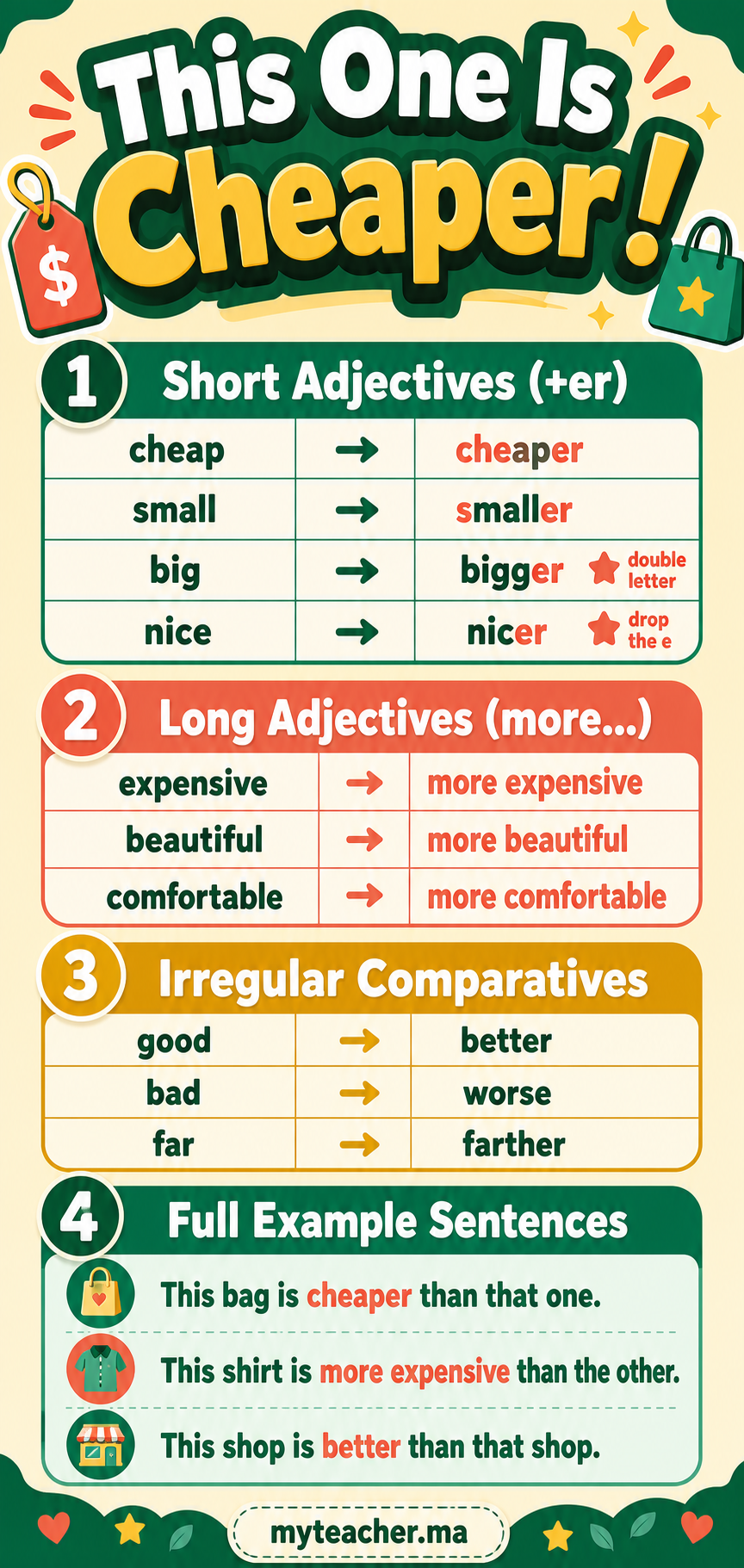
This One Is Cheaper! — Summary Card
Save this card on your phone to remember today's lesson!
⬇ Download the Summary CardTest Yourself!
-
cheap → ___
-
expensive → ___
-
good → ___
-
“This bag is cheaper ___ that one.”
Want More Lessons Like This?
This is one lesson from a full, illustrated study book for Common Core students — every unit, with practice and Arabic help for each lesson.
See the Complete Pack →
📱 Get MyTeacher as an app
Scan with your phone camera, then tap "Install" on the site to add it to your home screen.
Or open myteacher.ma on your phone