
Defining Concepts, Complaining & Apologizing
Three everyday functions in one lesson: explaining what something means, expressing dissatisfaction, and saying sorry.
What this lesson covers
This unit brings together three separate but common functions: defining a word or idea clearly, complaining when something is wrong, and apologizing when you’re the one at fault. All three appear often in the exam and in everyday conversation.
عن ماذا يتحدث هذا الدرس؟
تجمع هذه الوحدة بين ثلاث وظائف منفصلة لكنها شائعة: تعريف كلمة أو فكرة بوضوح، الشكوى عندما يكون هناك خطأ ما، والاعتذار عندما تكون أنت المخطئ. تظهر الوظائف الثلاث كثيرًا في الامتحان وفي المحادثات اليومية.
Defining Concepts
How to explain clearly what a word or idea means.
Expressions of definition
Use these phrases to explain the meaning of a word or concept clearly and formally — very useful when writing about vocabulary-heavy topics like culture.
A stereotype can be defined as a fixed, oversimplified idea about a group.
Making a Complaint
How to express that something is wrong, from mild to serious.
Complaint expressions
Complaints can range from a polite mention to a serious, formal objection. Choose the right level for the situation.
I have a serious complaint about the way this situation was handled.
Apologizing
How to say sorry sincerely — and how to respond when someone apologizes to you.
Apology expressions
I’m so sorry.
It’s all my fault.
Please forgive me for…
I apologize for…
I didn’t mean to…
That’s okay.
No problem at all.
Don’t worry about it.
I understand.
Please forgive me for forgetting your birthday.
See it in a dialogue
Customer: Excuse me, but there’s a problem with my order. This isn’t what I asked for.
Waiter: I’m sorry to hear that. Could you tell me more about it?
Customer: I ordered a vegetable dish, and this has meat in it. I have a serious complaint about this.
Waiter: I sincerely apologize for the mistake. I’ll bring you the correct dish right away.
Customer: Thank you, I appreciate that.
Makes a mild complaint.
Asks for more detail.
Escalates to a serious complaint.
Apologizes and offers a solution.
Accepts the apology.
Common mistakes to avoid
❌ Complaining without staying polite: “This is terrible!” → ✅ “I’m afraid I have a complaint about this.” (formal, controlled tone)
❌ I’m sorry about forgetting. → ✅ I’m sorry for forgetting. (apologize FOR something)
Your turn — choose the correct expression
-
1. “Culture ___ the way of life of a group of people.”
-
2. Which is a polite way to start a complaint?
-
3. Choose the correct sentence.
-
4. “It’s all my fault” is an example of ___.
-
5. Which phrase DEFINES a word?
-
6. A polite response to an apology is ___.
-
7. Choose the correct sentence.
-
8. “Please forgive me for…” is used when ___.
-
9. Which softens a complaint and keeps it polite?
-
10. Choose the correct definition expression.
-
11. “I didn’t mean to…” is used for ___.
-
12. Choose the correct sentence.
Write short responses for each situation:
- Define what “tolerance” means, using one of the expressions from this lesson.
- You received the wrong order at a restaurant. Make a polite complaint.
- You arrived late to meet a friend. Apologize, and imagine how they might respond.
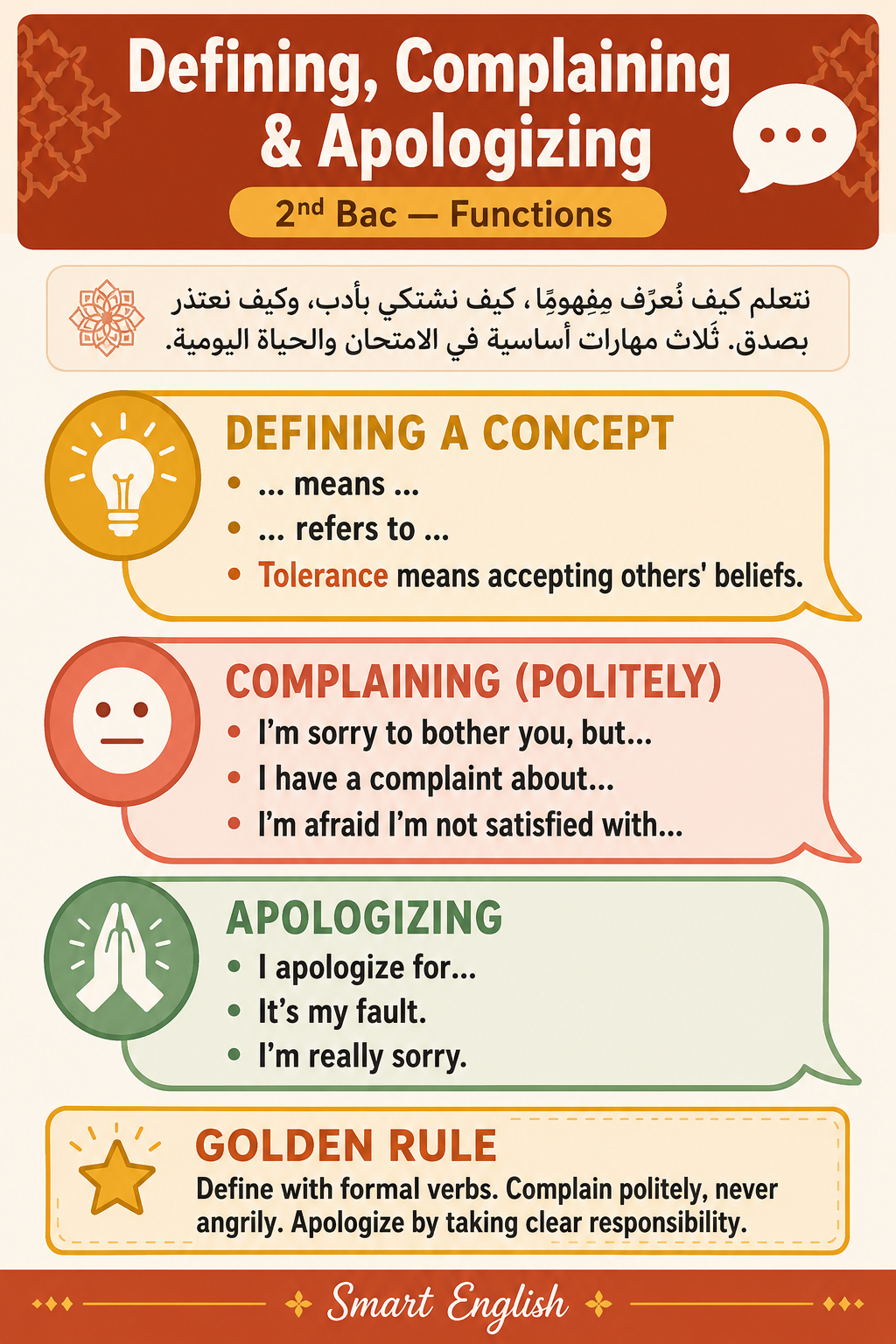
Here's your gift 🎁
A one-page summary of defining concepts, complaining, and apologizing — with all the key expressions. Save it and revise before your exam.
⬇ Get your gift
Smart English: From Stress to Success
40 visual lessons for all 10 units, a full exam guide, 3 sample exams, and a complete glossary — everything in one beautiful book.
Discover Smart English →
Scan with your phone camera, then tap "Install" on the site to add it to your home screen.
Or open myteacher.ma on your phone