
Mixed-Ability Classes in Morocco: How to Differentiate Without Extra Prep Time
One class, five different levels — and the same national exam waiting for all of them. Here's how to actually differentiate in a Moroccan classroom without writing three separate lesson plans a week.
 By My Teacher
·
August 9, 2026
·
7 min read
By My Teacher
·
August 9, 2026
·
7 min read

Walk into most Moroccan English classrooms and you’ll find the same thing: a handful of students who could hold a conversation in English right now, a large middle group working steadily but slowly, and a few who are still shaky on basics — all sitting in the same room, working from the same textbook, heading toward the same national exam.
“Differentiate your instruction” is easy advice to give and genuinely hard to do when you’re already short on time and planning one lesson a week is a stretch. So this isn’t a theory piece — it’s a set of techniques that differentiate without requiring you to write two or three separate lesson plans.
Why this is worth solving
Moroccan EFL research repeatedly names mixed proficiency levels within the same class as a major barrier to effective teaching — and notes that the pressure of covering a fixed, exam-driven syllabus makes it especially hard to slow down for some students without leaving others behind.
Same Activity, Different Depth
The fastest form of differentiation isn’t creating three different activities — it’s creating one activity with three depths built in.
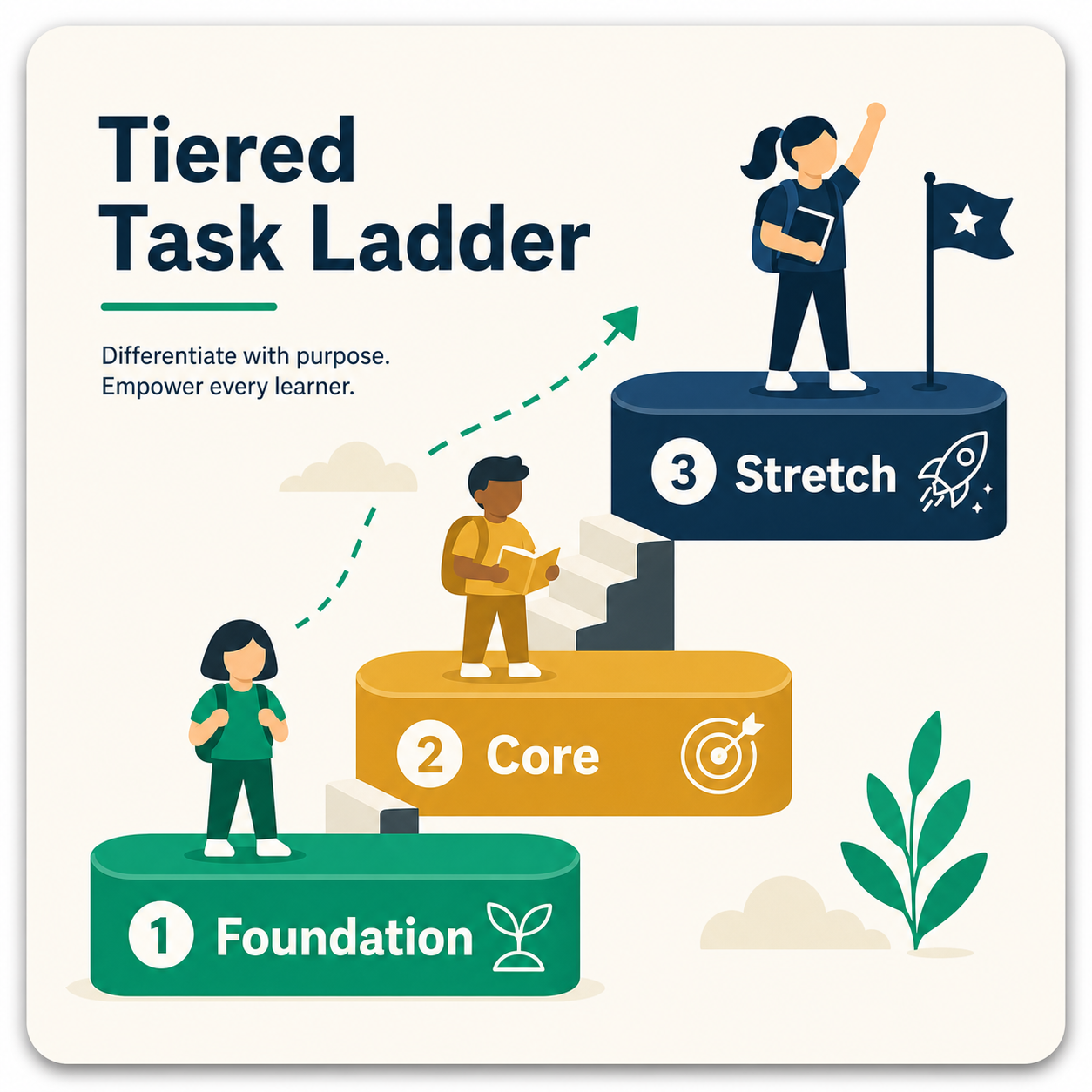
1. Build one task with three exit points
Design activities so every student can complete a basic version, but stronger students have somewhere further to go without needing new material. A reading task might ask everyone to answer three factual questions — but add an optional fourth: “Do you agree with the writer? Why?” Nobody is held back waiting for instructions on a “different” worksheet — it’s the same page for everyone.
2. Change the output, not the input
Give the whole class the same reading or listening text, but let students choose how they respond to it: a single sentence, a short paragraph, or a mini dialogue. Everyone engages with identical content at their own level of output — which is far faster to prepare than three separate texts.
3. Use “must, should, could” instructions
State tasks in three tiers out loud: “You must answer questions 1-3. You should try question 4. You could also write one extra sentence explaining your answer.” This costs you nothing extra to prepare and gives every student in the room a clear, achievable target regardless of level.
Say it, don't print it
You don’t need to formally print tiered worksheets to differentiate — saying the three tiers out loud, or writing them in three lines on the board, takes 20 seconds and works just as well for a 45-minute class.
Grouping Strategies That Don’t Need Extra Planning
Who sits with whom matters as much as what they’re doing — and smart grouping is free.
4. Mix levels for discussion, match levels for practice
For open discussion or speaking tasks, mixed-level pairs work well — stronger students naturally model language for weaker ones. For grammar drilling or accuracy practice, same-level pairs work better, since a much stronger partner tends to just supply the answer instead of letting a weaker student work through it.
5. Let stronger students “teach the row”
After you’ve explained something once, ask one confident student per row to explain it again to their immediate neighbors before you move on. This reinforces the strongest students’ own understanding while giving weaker students a second explanation in simpler language than yours — at zero extra cost to your prep time.
6. Rotate who gets called on first
If you always start with volunteers, you’ll always hear from the same five students. Instead, alternate: one day, cold-call from your stronger third first to set a model answer; the next day, start with your weaker third so their attempt isn’t compared instantly to a stronger one.
Fast Ways to Check Who’s Struggling
You can’t differentiate what you haven’t noticed. These take seconds, not minutes.
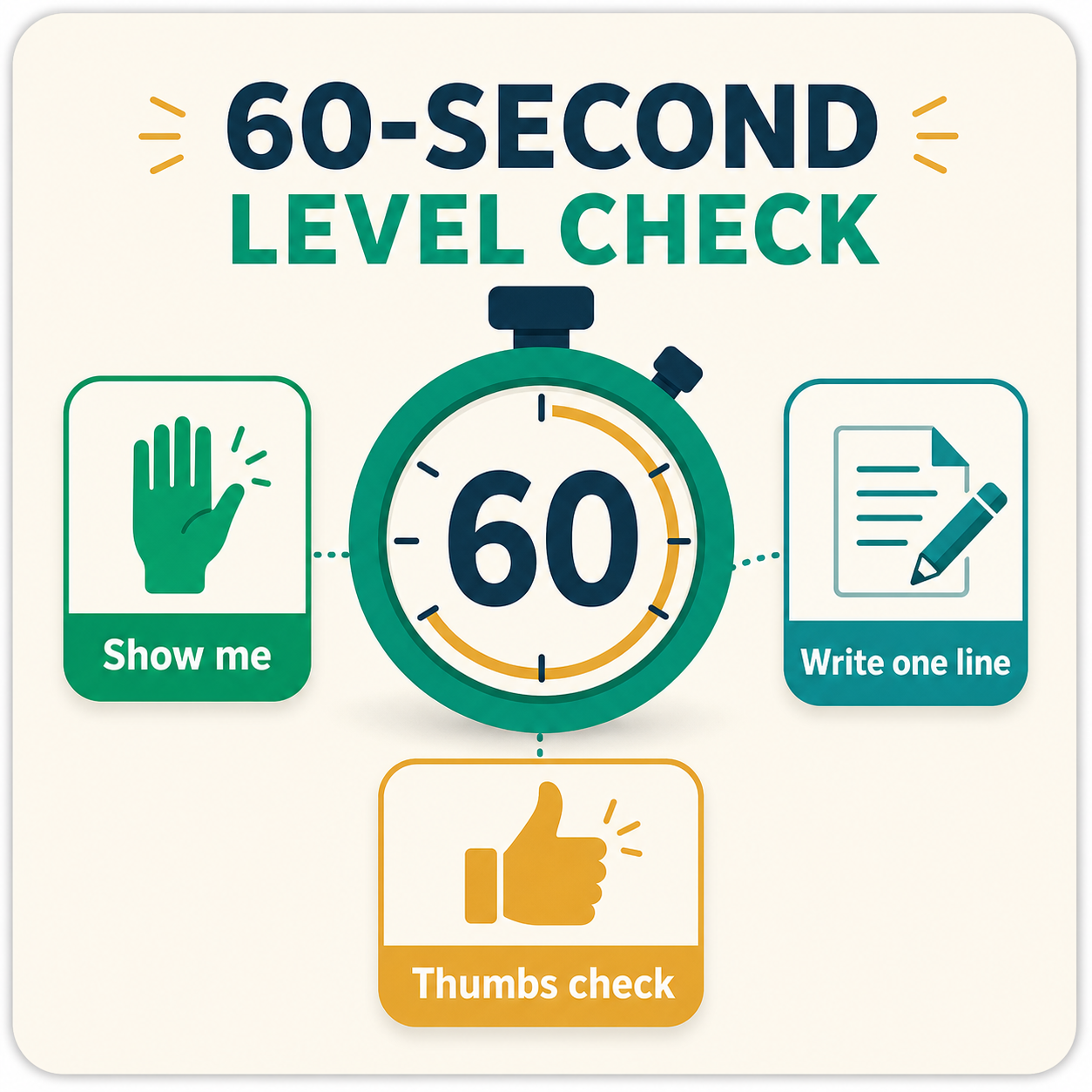
7. The 60-second level check
Before starting a new activity, ask a single diagnostic question and read the room in one of three ways: show of hands, one written line, or a simple thumbs up/sideways/down. In under a minute, you know roughly who needs more support today — without a single worksheet.
8. Watch who finishes first — and who doesn’t finish at all
You don’t need a formal test to track ability. Simply noting, over a couple of weeks, who consistently finishes early and who consistently doesn’t finish gives you a working map of your class without any extra assessment.
One Text, Multiple Tasks
This is the single highest-leverage differentiation technique for a teacher with limited prep time: keep the source material identical, and only vary the task.
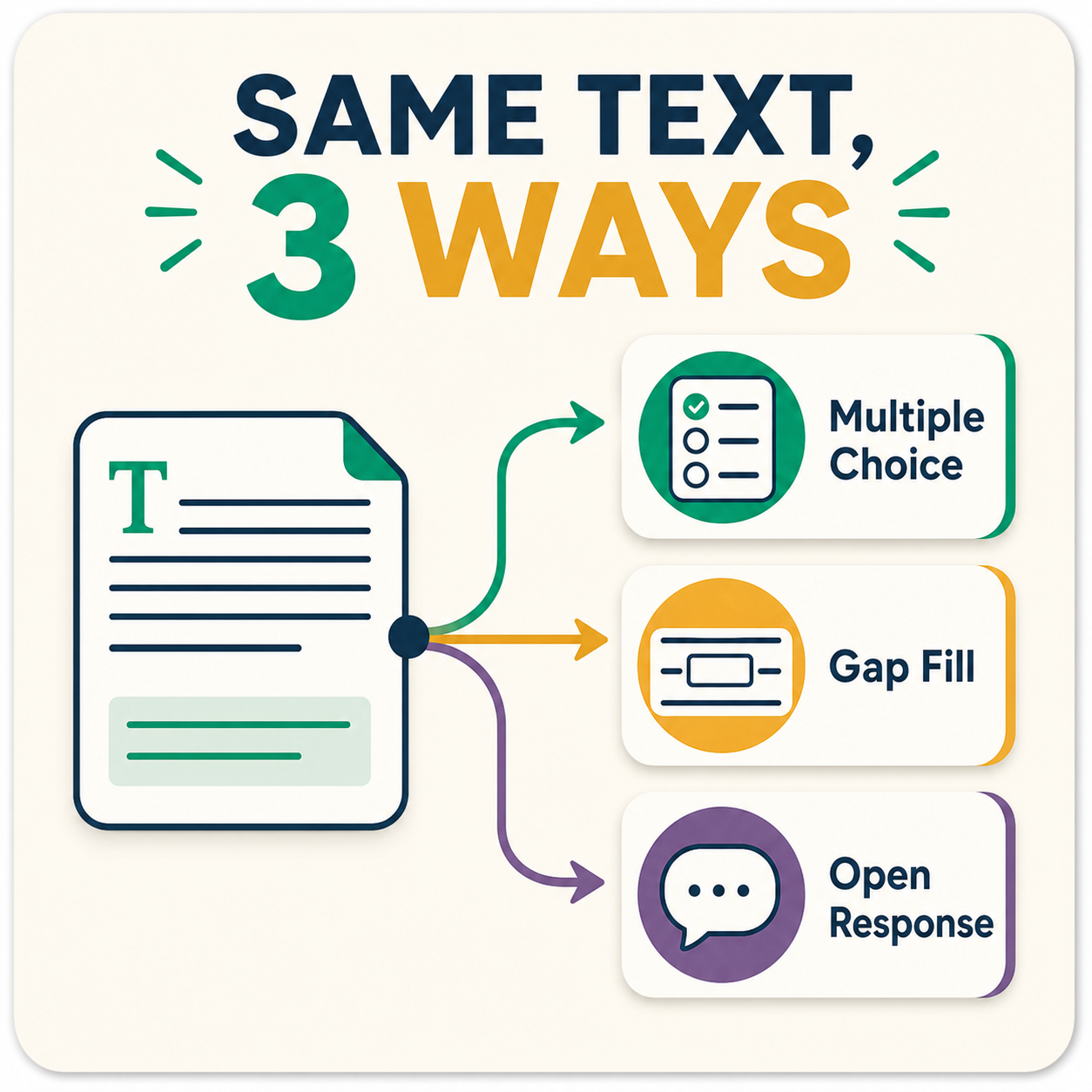
9. Multiple choice for foundation, gap-fill for core, open response for stretch
With any single reading or listening passage, weaker students can answer multiple-choice comprehension questions, middle-level students fill in the gaps in a summary, and stronger students answer an open question in their own words. You wrote one passage. Everyone is working at their actual level.
10. Vary the amount, not the difficulty
Sometimes the simplest differentiation is quantity: everyone answers questions 1 and 2, only some reach 3 and 4. Nobody feels singled out — the task simply has room to grow.
Where ready-made tiered material helps
Every worksheet in the Smart English Worksheets Complete Pack is built with a “Your Turn” section that naturally stretches stronger students beyond the guided practice — so the tiering described above is already built into the material rather than something you have to add yourself. A few sample lessons are available for free in the Worksheet Library if you’d like to see the structure first.
Putting It Together
None of this requires writing separate lesson plans for separate levels. It requires designing one lesson with built-in room to grow — through instructions, through grouping, and through how you phrase the task rather than through extra materials.
If you’re building lessons from the ground up, the Teacher Bundle‘s Tracker includes a monthly assessment sheet and grade sheets built around the Moroccan marking system — genuinely useful for keeping a running record of which students need the extra tier of support over time. The Textbook Directory can help you find lesson material matched exactly to your level and textbook.
In practice, it rarely means separate lesson plans for separate students. The most workable approach is one shared activity with built-in tiers — through optional extension questions, varied task types on the same text, or flexible output (a sentence vs. a paragraph) — rather than fully separate materials for each level.
Quick, informal checks work well: a single diagnostic question answered by show of hands, one written line, or a thumbs-up scale, done in under a minute before an activity starts. Tracking who consistently finishes early versus who consistently runs out of time over a couple of weeks also builds a reliable picture without any extra assessment.
It depends on the task. For open discussion or speaking practice, mixed-level pairs tend to work well because stronger students naturally model language. For accuracy-focused practice like grammar drills, same-level pairs usually work better, since a much stronger partner will often just supply the answer.
Keep the source material — a text, a passage, a set of questions — identical for the whole class, and vary only the task type or the amount of it: multiple choice versus open response on the same passage, or “must answer 1-3, could also try 4.” This differentiates without doubling your prep time.
The Teacher Bundle
A complete Record Book, Tracker, and bonus Lesson Planner — everything to plan, teach, and track your school year in one beautiful set.
Discover The Teacher Bundle →
Scan with your phone camera, then tap "Install" on the site to add it to your home screen.
Or open myteacher.ma on your phone