
Past Perfect Simple & Continuous
Learn to talk about the earlier of two past events — the exam's favourite way to test your grammar.
Why we need the past perfect
When you talk about two things that happened in the past, English needs a way to show which one happened first. The past perfect does exactly that — it points to the earlier action, while the past simple stays for the later one.
لماذا نحتاج إلى الماضي التام؟
عندما نتحدث عن حدثين وقعا في الماضي، تحتاج اللغة الإنجليزية إلى طريقة لتوضيح أيهما وقع أولًا. الماضي التام (Past Perfect) يقوم بهذه المهمة بالضبط — يشير إلى الحدث الأقدم، بينما يبقى الماضي البسيط (Past Simple) للحدث الذي وقع بعده.
Past Perfect Simple
Use had + past participle for the earlier of two past actions — usually a completed action.
Zineb came back to Morocco after she had graduated from Cambridge.
Past Perfect Continuous
Use had been + verb-ing to focus on the duration of an action that was still going on right up until another past moment.
My sister and her husband had been living in France for ten years before they came back to Morocco.
Simple or Continuous — which one?
Focuses on the result or the fact that something was completed.
He had written three books before he turned thirty. (the result: three finished books)
Focuses on the duration — how long the action continued.
He had been writing for three hours when the power went out. (emphasis on the length of time)
Words that signal the past perfect
These time words often appear in the same sentence as the past perfect — learn to recognise them.
By the time the teacher arrived, the students had already started the test.
A worked example
Read this short passage. Notice how the past perfect always marks the event that happened earlier.
I joined university in 1996 to study English after I had taken my baccalaureate from a high school in Ouarzazate. Before that, I had chosen to study letters. I had been learning English for four years in Agadir; then, I graduated in 2000.
had taken → happened before joining university.
had chosen → an earlier decision.
had been learning → emphasises the FOUR YEARS of duration before graduating.
Common mistakes to avoid
❌ Using the past perfect for the ONLY event in a sentence: Yesterday, I had gone to school. → ✅ Yesterday, I went to school. (past perfect always needs a SECOND past event to compare to)
❌ She had went. → ✅ She had gone. (use the past participle, not the past simple form)
Your turn — choose the correct form
-
1. By the time I got to the office, the meeting ___ already ___.
-
2. We were tired because we ___ for hours.
-
3. Zineb came back to Morocco after she ___ from Cambridge.
-
4. Choose the correct sentence.
-
5. Past perfect CONTINUOUS is used to emphasise ___.
-
6. I ___ never ___ Italian food before that dinner.
-
7. Which sentence needs the past perfect?
-
8. They ___ for an hour when the bus finally came.
-
9. Choose the word that often signals past perfect.
-
10. He had written three books ___.
-
11. My sister ___ in France for ten years before she came back.
-
12. Which formula is correct for past perfect continuous?
Complete each sentence with the correct past perfect form (simple or continuous):
- When the teacher arrived, the students ___ (already / finish) the test.
- I was exhausted because I ___ (study) all night.
- She ___ (never / travel) abroad before last summer.
- By the time he was 25, he ___ (write) two novels.
- We ___ (wait) for an hour when the train finally arrived.
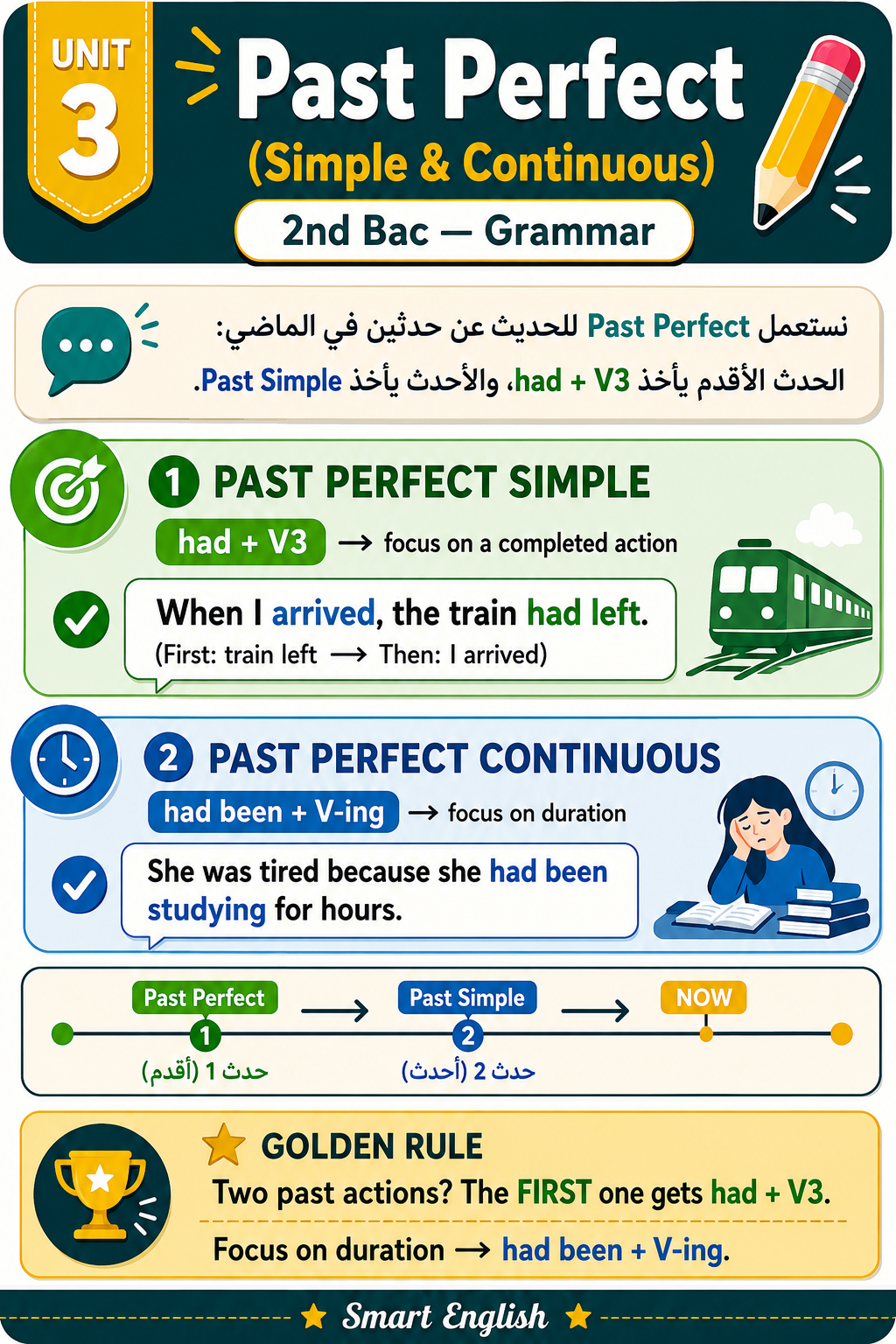
Here's your gift 🎁
A one-page summary of the past perfect simple and continuous — formulas, signal words, and examples. Save it and revise before your exam.
⬇ Get your gift
Smart English: From Stress to Success
40 visual lessons for all 10 units, a full exam guide, 3 sample exams, and a complete glossary — everything in one beautiful book.
Discover Smart English →
Scan with your phone camera, then tap "Install" on the site to add it to your home screen.
Or open myteacher.ma on your phone