
How to Cut Your Correction & Marking Time in Half (Without Cutting Corners)
Marking 45 copybooks a night isn't sustainable, and it isn't necessary. Here's a practical system for cutting your correction time without giving students any less feedback.
 By My Teacher
·
August 9, 2026
·
7 min read
By My Teacher
·
August 9, 2026
·
7 min read

Forty-five copybooks. Every single evening, if you correct the way most of us were trained to — full sentences, every mistake, every book, every time. That’s not a sustainable system. It’s a countdown to burnout with a red pen.
None of what follows means giving students less feedback. It means being deliberate about which feedback actually needs your full attention, and building a system so marking a class set takes twenty minutes instead of two hours.
A quietly universal problem
Correction and marking load is consistently named among the most time-consuming parts of an English teacher’s week — and the burden scales directly with class size, which in Moroccan public schools often means marking sets of 40 or more books per assignment, per class, multiple times a week.
Why Marking Eats More Time Than It Should
Most marking systems aren’t slow because teachers are inefficient — they’re slow because every piece of work gets treated the same way, regardless of how much detailed feedback it actually needs. A quick vocabulary gap-fill and a full written paragraph don’t require the same depth of correction, but they often get it anyway, out of habit.
Correction Systems That Work Faster By Design
1. Use symbol-based correction instead of full rewrites
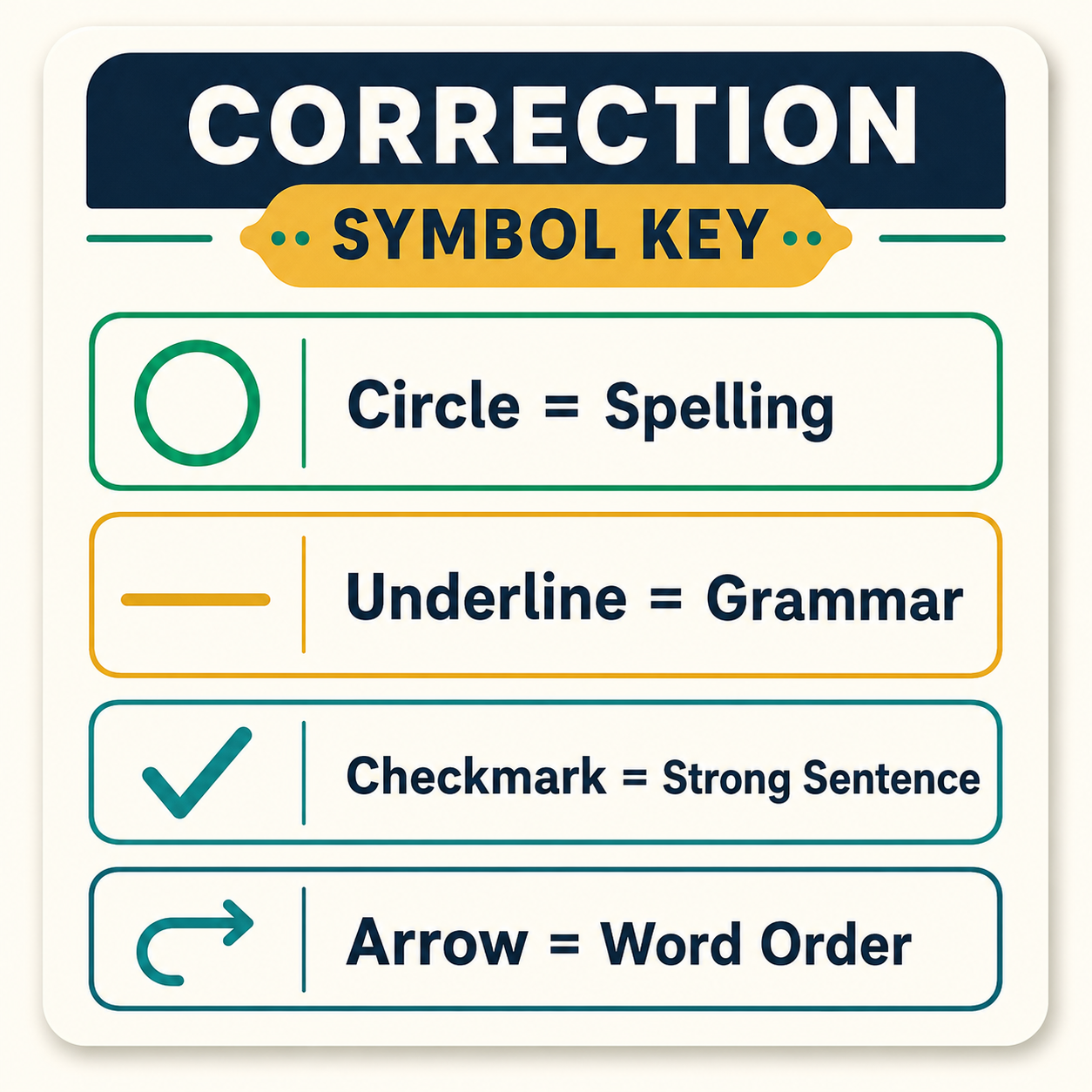
A small, consistent set of margin symbols — a circle for spelling, an underline for grammar, a checkmark for a strong sentence — lets you flag exactly what needs attention without writing out full corrections yourself. It also trains students to self-correct, which full rewrites never do.
2. Sample instead of marking every single item
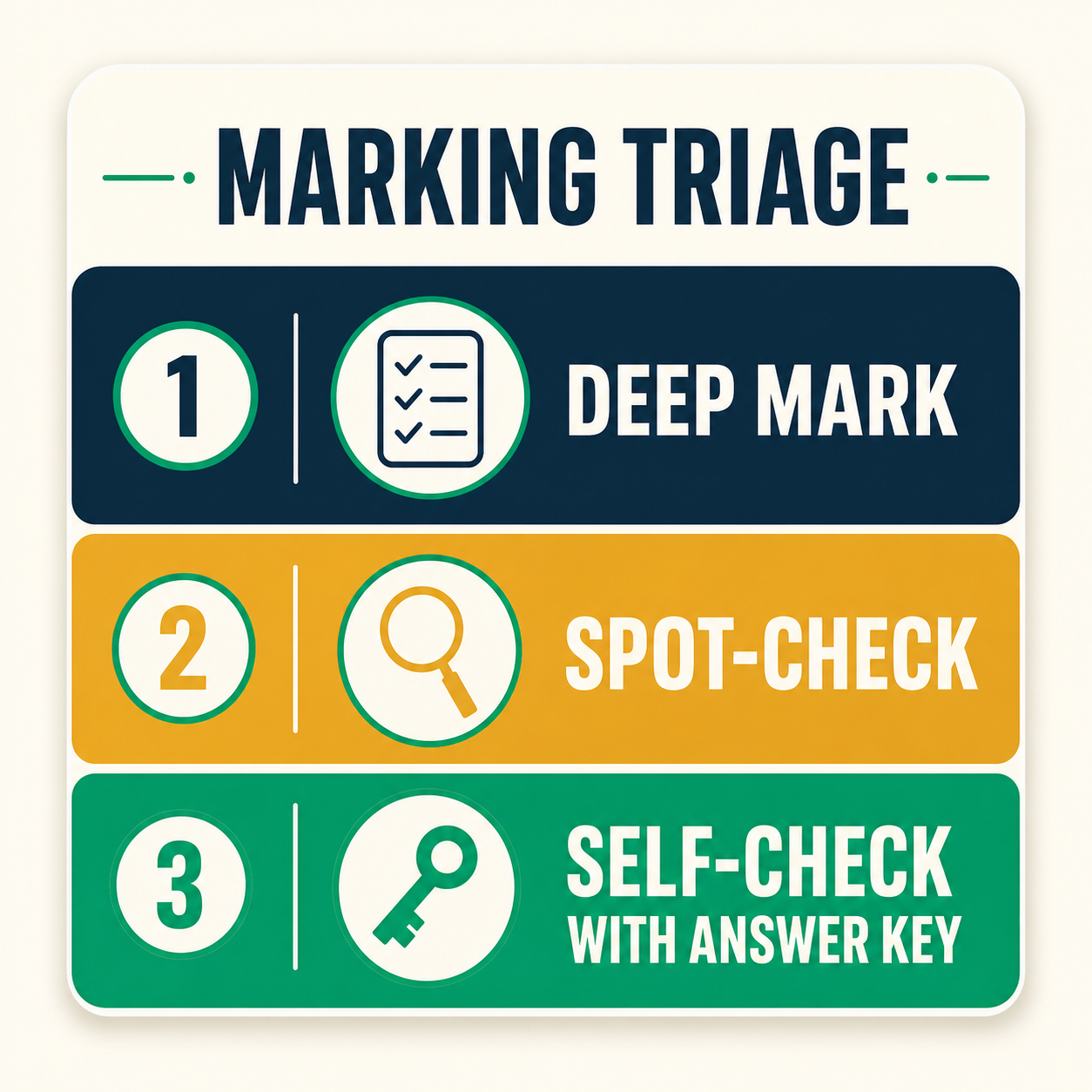
For longer exercises, correcting five representative answers in detail often reveals the same error patterns as correcting all twenty — and takes a fraction of the time. Full coverage matters far more for final written work than for routine practice exercises.
3. Let answer keys do the first pass
For objective exercises — grammar gap-fills, vocabulary matching, multiple choice — a posted or shared answer key lets students self-check or peer-check before any work reaches you. You’re then only spending time on genuine errors, not re-confirming answers that were already correct.
Reducing How Much You Have to Mark In the First Place
The fastest way to cut marking time isn’t marking faster — it’s being intentional about what actually needs marking at all.
4. Not every task needs a grade
Warm-ups, informal practice, and low-stakes writing can be checked for completion rather than graded in detail — a quick glance and a tick achieves the accountability purpose without the correction time.
5. Reserve deep marking for what’s actually assessed
Save detailed, sentence-level correction for the work that counts toward a grade — a formal written assignment, a test. Practice exercises leading up to it can be marked far more lightly, since their purpose is rehearsal, not evaluation.
6. Give feedback live, in class, when you can
Circulating during an in-class writing task and giving verbal or quick written feedback in the moment often replaces an entire evening of take-home correction — and it reaches the student while the task is still fresh, which tends to land better anyway.
Batch and Systemize Your Marking Time
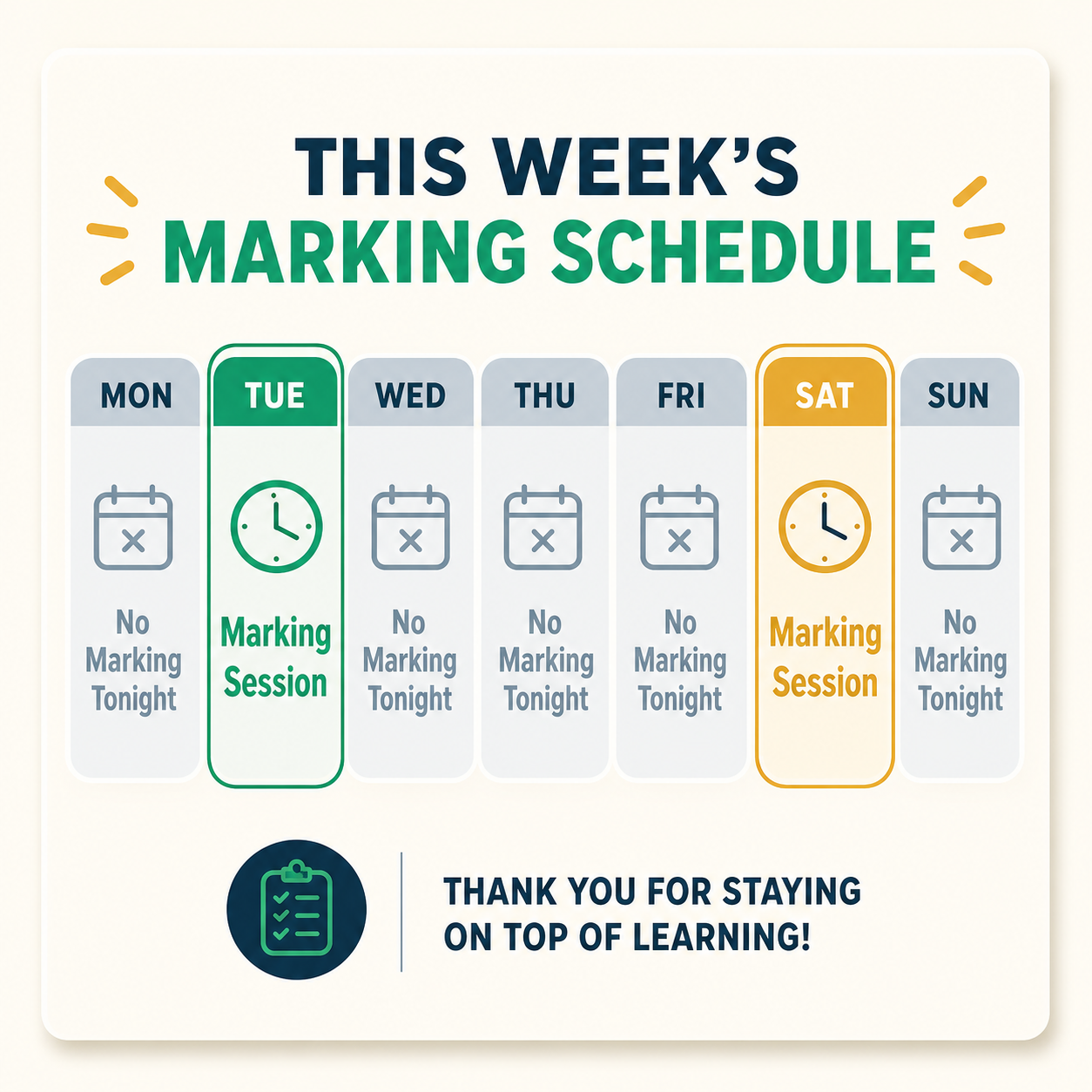
7. Fix two marking sessions a week, not nightly correction
Correcting a little every single evening feels manageable in the moment but rarely stays contained — it expands to fill whatever time exists. Two dedicated, scheduled marking sessions a week create a hard boundary and, in practice, get through the same volume of work.
8. Mark the same exercise across all your classes in one sitting
Correcting question one across every student’s book before moving to question two, rather than working through each book front to back, keeps the correct answer fresh in your mind and noticeably speeds up pattern recognition in student errors.
9. Use a simple rubric instead of full commentary for longer work
A short checklist — structure, grammar, vocabulary use, task completion — marked with quick ticks or brief notes communicates what needs improvement just as clearly as a paragraph of commentary, in a fraction of the writing time.
Recording Marks Efficiently Once You’ve Graded
10. Keep one consistent system for recording marks all year
Switching between different tracking formats — a notebook one term, loose sheets the next — costs time reconstructing where you left off. One consistent grade sheet, used the same way from September to June, removes that friction entirely.
11. Note patterns while marking, not just scores
A brief note — “several students still confusing past simple and present perfect” — jotted down while marking takes seconds and saves you from re-discovering the same pattern independently when planning your next lesson.
Where this gets structurally easier
Every worksheet in the Smart English Worksheets Complete Pack comes with a pre-written answer key for every unit, so the self-check and peer-check approach above is ready to use immediately rather than something you have to build yourself. A few sample lessons with their answer keys are free to try in the Worksheet Library. And for recording marks once you’re done, the Teacher Bundle‘s grade sheets are already structured around the Moroccan marking system, so there’s one consistent place for scores all year rather than a system you have to design from scratch.
Putting It Together
Cutting marking time isn’t about correcting faster — it’s about being deliberate about what genuinely needs your full attention, and building a consistent system so you’re never reinventing your correction process from one assignment to the next. Start with symbol-based correction and two fixed weekly marking sessions; those two changes alone tend to be the difference between marking every evening and marking on a schedule.
Use symbol-based correction instead of full rewrites, sample a portion of longer exercises instead of correcting every item, and reserve deep, detailed marking for work that’s formally assessed rather than routine practice. Batching marking into two fixed sessions a week rather than nightly correction also meaningfully reduces total time spent.
It’s a small, consistent set of margin symbols — for example, a circle for a spelling error, an underline for a grammar error, and a checkmark for a strong sentence — used in place of writing out full corrections. It’s faster for the teacher and trains students to self-correct rather than passively reading a rewritten answer.
No — routine practice and warm-up tasks can be checked for completion rather than graded in detail, with deep marking reserved for work that’s formally assessed, like a test or a graded written assignment. This distinction alone removes a large share of unnecessary marking time.
For objective exercises like grammar gap-fills or vocabulary matching, a shared answer key allows students to self-check or peer-check before the work reaches the teacher, meaning teacher time is spent only on genuine, remaining errors rather than reconfirming already-correct answers.
The Teacher Bundle
A complete Record Book, Tracker, and bonus Lesson Planner — everything to plan, teach, and track your school year in one beautiful set.
Discover The Teacher Bundle →
Scan with your phone camera, then tap "Install" on the site to add it to your home screen.
Or open myteacher.ma on your phone