
Relative Pronouns and Clauses
Learn to add extra information about a person, thing, or place — and when that information needs commas.
What relative clauses do
A relative clause adds extra information about a noun without starting a new sentence. It’s joined using a relative pronoun — who, which, whose, where, when, or that — and it makes your writing more detailed and connected.
ما وظيفة جملة الصلة (Relative Clause)؟
تضيف جملة الصلة معلومة إضافية عن اسم معين دون البدء بجملة جديدة. تُربط باستخدام ضمير الوصل — who, which, whose, where, when, أو that — مما يجعل كتابتك أكثر تفصيلاً وترابطًا.
The relative pronouns
Graduates whose grades are the highest are often offered jobs abroad.
Defining vs. non-defining clauses — the key rule
This is exactly what the exam tests: some relative clauses are essential to the meaning; others just add extra detail.
Essential information — without it, the sentence loses its meaning.
No commas.
Countries that lose many skilled workers often struggle economically.
Extra information — the sentence still makes sense without it.
Commas required.
Morocco, which has invested heavily in education, still faces brain drain.
More examples
Engineers who can’t find work at home often look abroad. (defining — essential to the meaning)
The country where she was born no longer has enough doctors.
Common mistakes to avoid
❌ Missing commas in a non-defining clause: Morocco which invests in education still faces brain drain. → ✅ Morocco, which invests in education, still faces brain drain.
❌ The scientist which won the award… → ✅ The scientist who won the award… (who for people, which for things)
Your turn — choose the correct relative pronoun
-
1. My uncle, ___ emigrated to Canada, is a successful engineer.
-
2. Countries ___ lose many skilled workers often struggle economically.
-
3. Choose the correct sentence.
-
4. Graduates ___ grades are the highest often find jobs abroad.
-
5. Which pronoun is used for PLACES?
-
6. Choose the correct sentence.
-
7. In a non-defining clause, you can NEVER use ___.
-
8. A defining clause is ___ to the sentence’s meaning.
-
9. Choose the correct sentence.
-
10. Non-defining clauses always need ___.
-
11. Which pronoun shows POSSESSION?
-
12. Choose the correct sentence.
Combine each pair of sentences using a relative pronoun. Decide whether commas are needed:
- My cousin is a doctor. She emigrated to France last year.
- Morocco has invested in education. Morocco still faces brain drain.
- The engineers left the country. Their salaries were too low.
- I visited the city. My grandfather was born there.
- Scientists often move abroad. Scientists can’t find funding at home.
Here's your gift 🎁
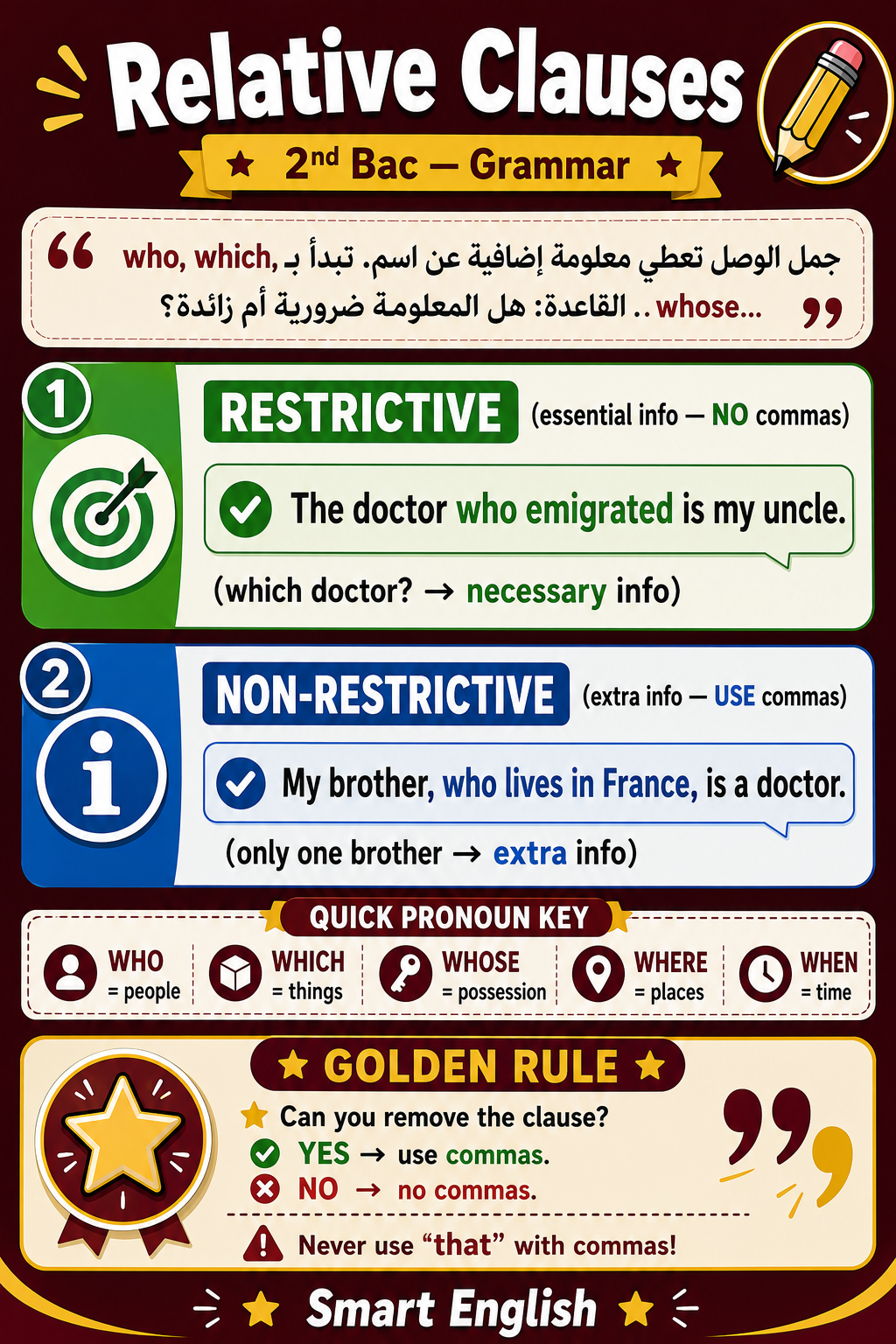
A one-page summary of relative pronouns and clauses — defining vs. non-defining, with examples. Save it and revise before your exam.
⬇ Get your gift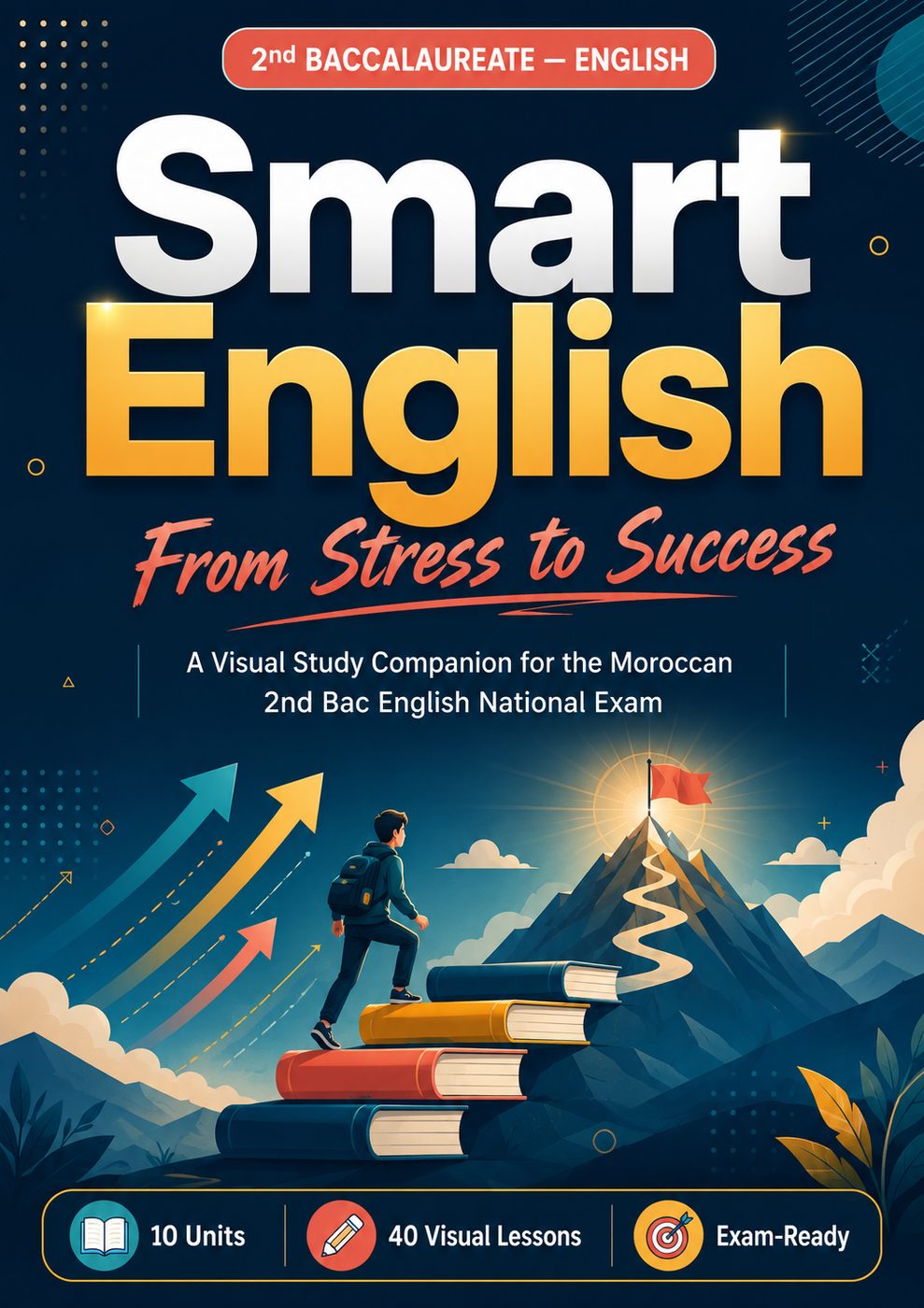
Smart English: From Stress to Success
40 visual lessons for all 10 units, a full exam guide, 3 sample exams, and a complete glossary — everything in one beautiful book.
Discover Smart English →
Scan with your phone camera, then tap "Install" on the site to add it to your home screen.
Or open myteacher.ma on your phone