
Writing a Report
Learn to report on an event — a seminar, workshop, or conference — clearly, formally, and in the structure the exam expects.
What the exam asks
In this task, you report on an event you attended — usually a seminar, workshop, or conference at your school, often about an education-related topic. Unlike a personal story, a report is formal and factual: you’re informing the reader, not entertaining them.
ماذا يطلب الامتحان؟
في هذه المهمة، تكتب تقريرًا عن حدث حضرته — عادة ندوة، ورشة عمل، أو مؤتمر في مدرستك، غالبًا حول موضوع يتعلق بالتعليم. على عكس القصة الشخصية، التقرير رسمي ومبني على الحقائق — مهمتك أن تُعلم القارئ، لا أن تُسليه.
The structure
A report follows a clear, predictable shape. Stick to it every time.
Title — a short heading naming the event. “Report on the School Seminar on Dropout Students”
1) The introduction
Open by naming the event and covering the basic facts: date, place, organiser, and purpose.
2) The body
This is the main part — describe what actually happened: who spoke, what was discussed, and what activities took place. Keep it factual and in order.
3) The conclusion
Close with a short summary of the main outcome, or a recommendation based on what was discussed.
A model report
Here is a short, complete example. Notice how factual and organised it stays throughout.
Report on a School Seminar on Dropout Students
Last week, our school held a seminar on dropout students. The event brought together educators, policymakers, and community leaders to discuss the issue and identify solutions.
The keynote speaker highlighted the seriousness of the problem. Several other speakers presented different aspects of it, and participants took part in group discussions. One suggestion was to support students from disadvantaged backgrounds; another was to involve parents more actively.
Overall, the seminar showed that solving the dropout problem requires a combined effort from schools, families, and the community.
Title.
Introduction: when, what, who, why.
Body: what happened, in order.
Conclusion: summary + takeaway.
Common mistakes to avoid
❌ No structure: jumping between ideas → always follow title → introduction → body → conclusion.
❌ Mixing tenses: switching between past and present → stay in the past simple throughout.
Your turn — test your understanding
-
1. A report should be written in a ___ tone.
-
2. What comes FIRST in a report?
-
3. Which tense is mainly used in a report?
-
4. “Last week, our school held a seminar on…” is an example of the ___.
-
5. The BODY of a report should describe ___.
-
6. Which phrase fits the conclusion?
-
7. “The keynote speaker highlighted…” belongs in the ___.
-
8. A good report avoids ___.
-
9. Which is a good report title?
-
10. The introduction should include date, place, organiser and ___.
-
11. Choose the correct sentence.
-
12. A recommendation is most likely to appear in the ___.
Write a short report (about 8–10 sentences) about ONE of these:
- A workshop on environmental awareness at your school
- A conference on career guidance for students
- A cultural event or exhibition you attended
Follow the structure: title → introduction (when/where/who/why) → body (what happened) → conclusion (summary or recommendation). Keep the tone formal and stay in the past simple.
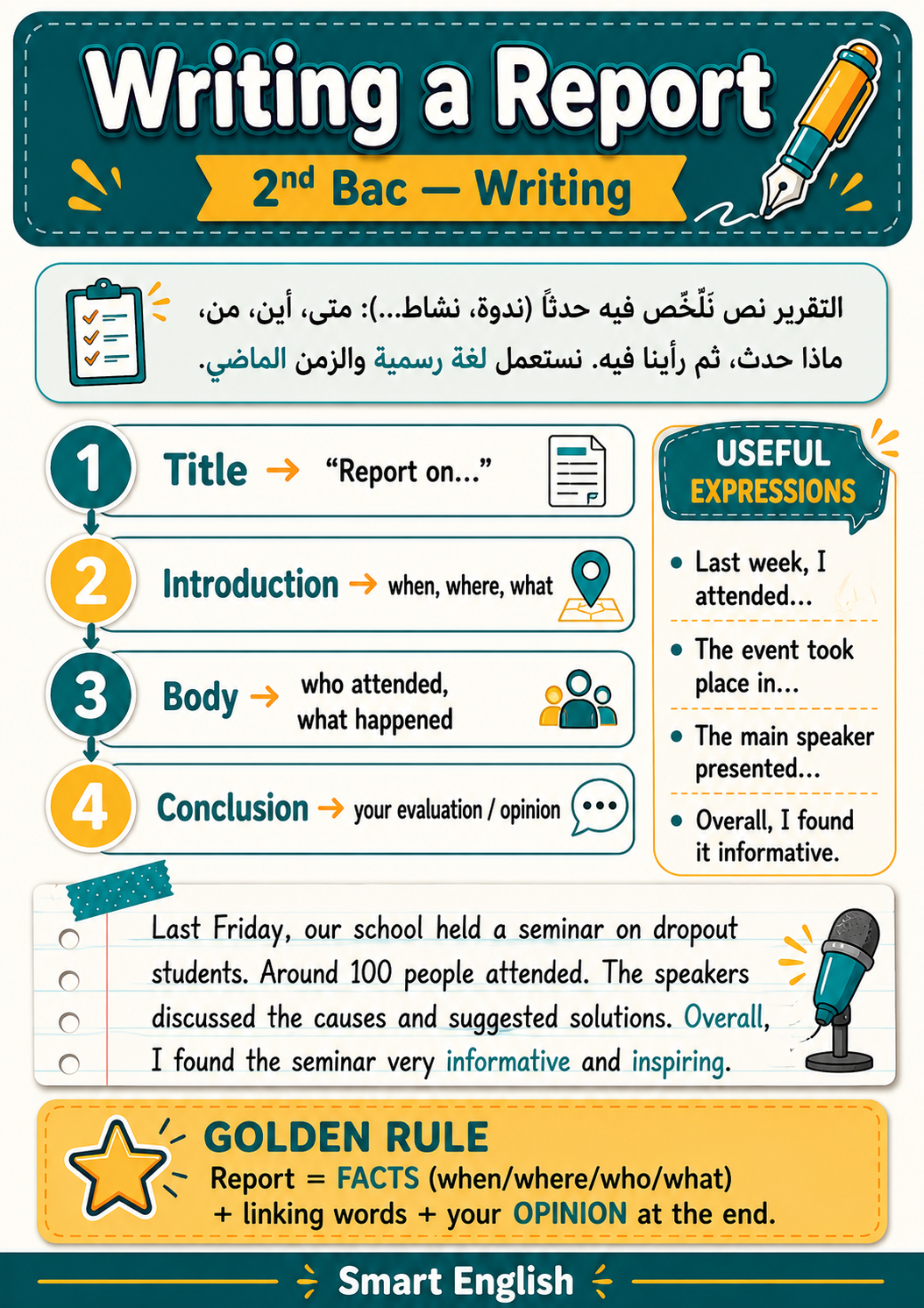
Here's your gift 🎁
A one-page summary of how to write a report — structure, useful phrases, and a model. Save it and use it for every report writing task.
⬇ Get your gift
Smart English: From Stress to Success
40 visual lessons for all 10 units, a full exam guide, 3 sample exams, and a complete glossary — everything in one beautiful book.
Discover Smart English →
Scan with your phone camera, then tap "Install" on the site to add it to your home screen.
Or open myteacher.ma on your phone