
How to Teach English in Overcrowded Classrooms (40+ Students): 12 Strategies That Actually Work
Class sizes of 40, sometimes 50 students, are the everyday reality in Moroccan public schools. Here are 12 concrete, no-extra-materials strategies for keeping order, tracking participation, and actually teaching — not just managing chaos.
 By My Teacher
·
August 9, 2026
·
8 min read
By My Teacher
·
August 9, 2026
·
8 min read

If you’re teaching English in a Moroccan public school, there’s a decent chance your class has more students in it than the room was ever designed for. Forty is common. Fifty isn’t rare. And most of the classroom management advice floating around online was written by someone with 22 students, a projector, and a teaching assistant.
None of that applies here. So this guide doesn’t either — every strategy below assumes a full room, a chalkboard, and zero extra materials, because that’s the actual job.
The reality, in numbers
Research on Moroccan EFL classrooms consistently names class size as the single most cited challenge teachers face — with some public school classes reaching 50 students, well above the 20-student threshold researchers associate with manageable acquisition and classroom control.
Before the Lesson Starts: Set Up for Fewer Problems
Most classroom chaos isn’t a discipline problem — it’s a setup problem. Fix the setup and half your management issues disappear before the lesson even begins.
1. Zone your classroom, even if you can’t move the furniture
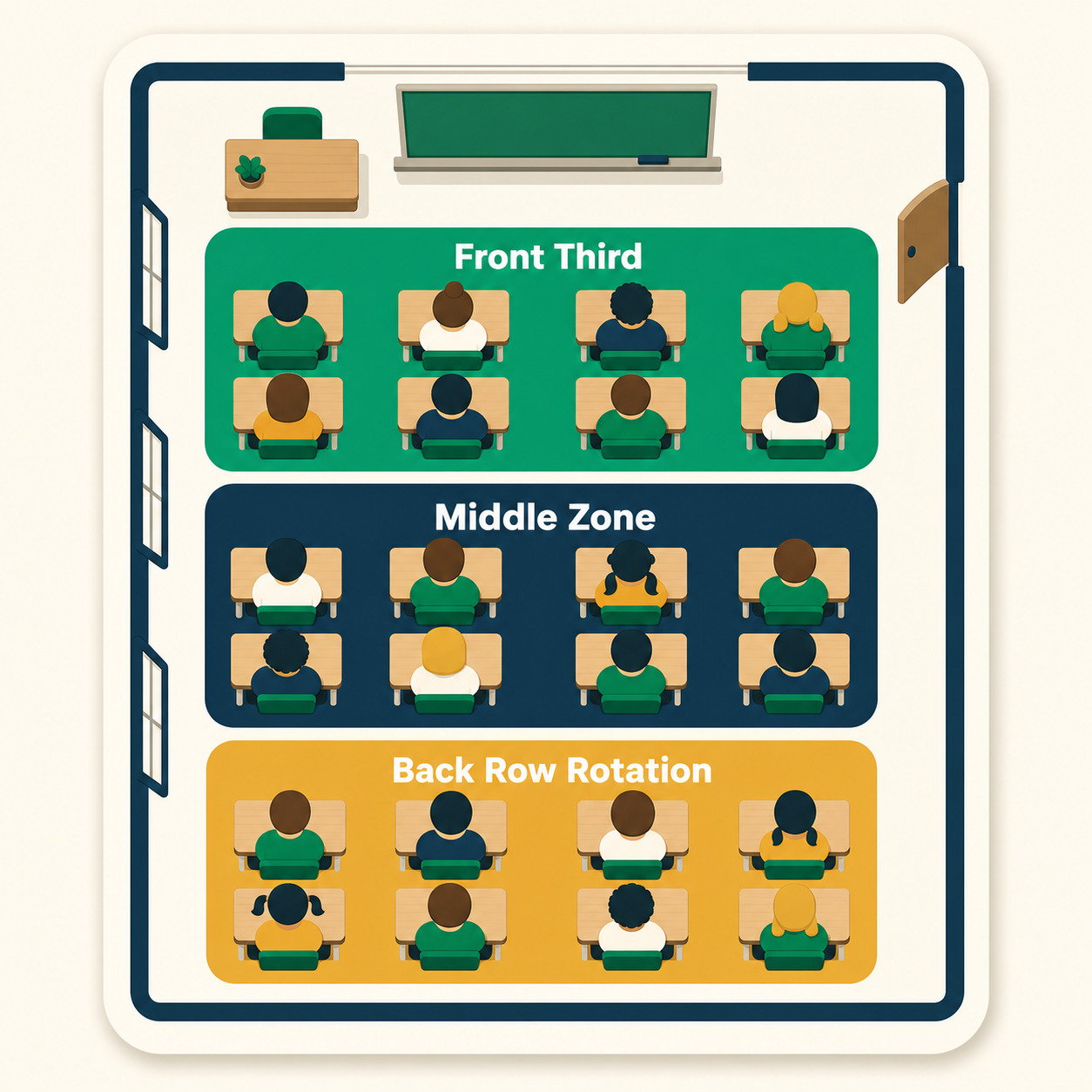
You probably can’t rearrange desks into islands with 45 students crammed into a small room — but you can mentally (and verbally) divide the room into three zones: front third, middle, and back row. Rotate which zone answers questions, reads aloud, or gets called on first, on a simple weekly rotation. Nobody feels permanently ignored, and you’re not scanning 50 faces at once trying to decide who to call on.
2. Assign one no-cost classroom job per row
A “row leader” who collects papers, checks that neighbors have books open, or reports who’s missing — one per row of roughly 8-10 students — hands you eyes and hands you don’t have. Rotate the job weekly. It costs nothing and gives you real-time information about a room too big to monitor alone.
3. Decide your rules before you need them
Walking in without pre-decided responses to “no textbook,” “talking during instructions,” or “late arrival” means you’re improvising discipline in front of 45 students — and improvised discipline is inconsistent discipline, which large classes punish immediately. Decide your three or four responses once, at the start of the year, and apply them the same way every time.
Keep it to 3-4 rules, not 10
More than four rules becomes impossible for you to enforce consistently and for students to remember — and inconsistent enforcement is what actually causes classroom management to break down in large groups, not the rule itself.
During the Lesson: Keep Everyone Engaged at Once
The core problem with 45 students isn’t noise — it’s that you can only meaningfully interact with a handful of them per activity. These techniques are built to multiply your reach without multiplying your workload.
4. Use choral response before individual response
Before calling on one student, get the whole class answering together — chorally, on your signal. It warms up quieter students, catches errors early, and means every single student in the room has actually produced the answer before you ever ask one individual to repeat it publicly.
5. Use the “everyone writes, then I pick” method
Instead of asking a question and waiting for hands, give 30 seconds for every student to write a one-line answer on paper or in their notebook, then cold-call. Every student did the thinking — you just didn’t have time to see all 45 answers, and that’s fine. The learning happened whether or not you saw it.
6. Give instructions in a fixed, predictable sequence
In a large room, repeated or unclear instructions are what triggers the noise spiral. Use the exact same structure every time — say it once, model it once, ask one student to repeat it back, then start. Students stop asking “what do we do?” once the sequence itself becomes familiar.
“Teachers who rely on non-verbal cues and a fixed instructional routine report significantly fewer disruptions than those who repeat verbal instructions multiple times per lesson.”
— Common finding across Moroccan EFL classroom studies
7. Use a silent attention signal — every single time
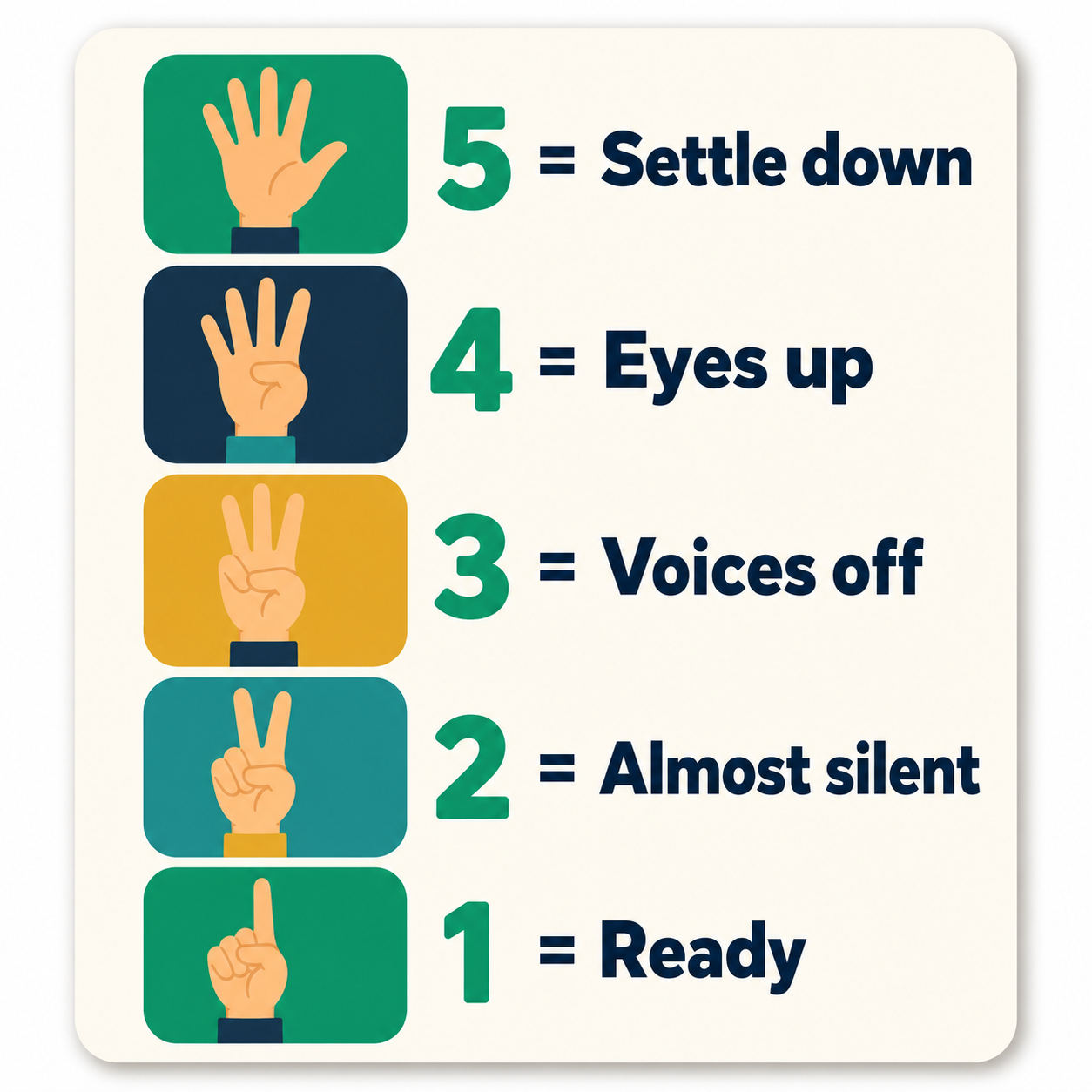
Raising your voice over 45 students trains them to wait for you to shout before they quiet down. A consistent silent signal — a hand-count, a specific gesture — trains the opposite: silence is the expected response to the signal, not to volume.
Managing Movement, Noise & Attention
Pair and group work is where large classes fall apart fastest — not because the activity is bad, but because 45 students working simultaneously sounds identical whether the discussion is on-topic or not.
8. Set a visible noise ceiling before group work starts
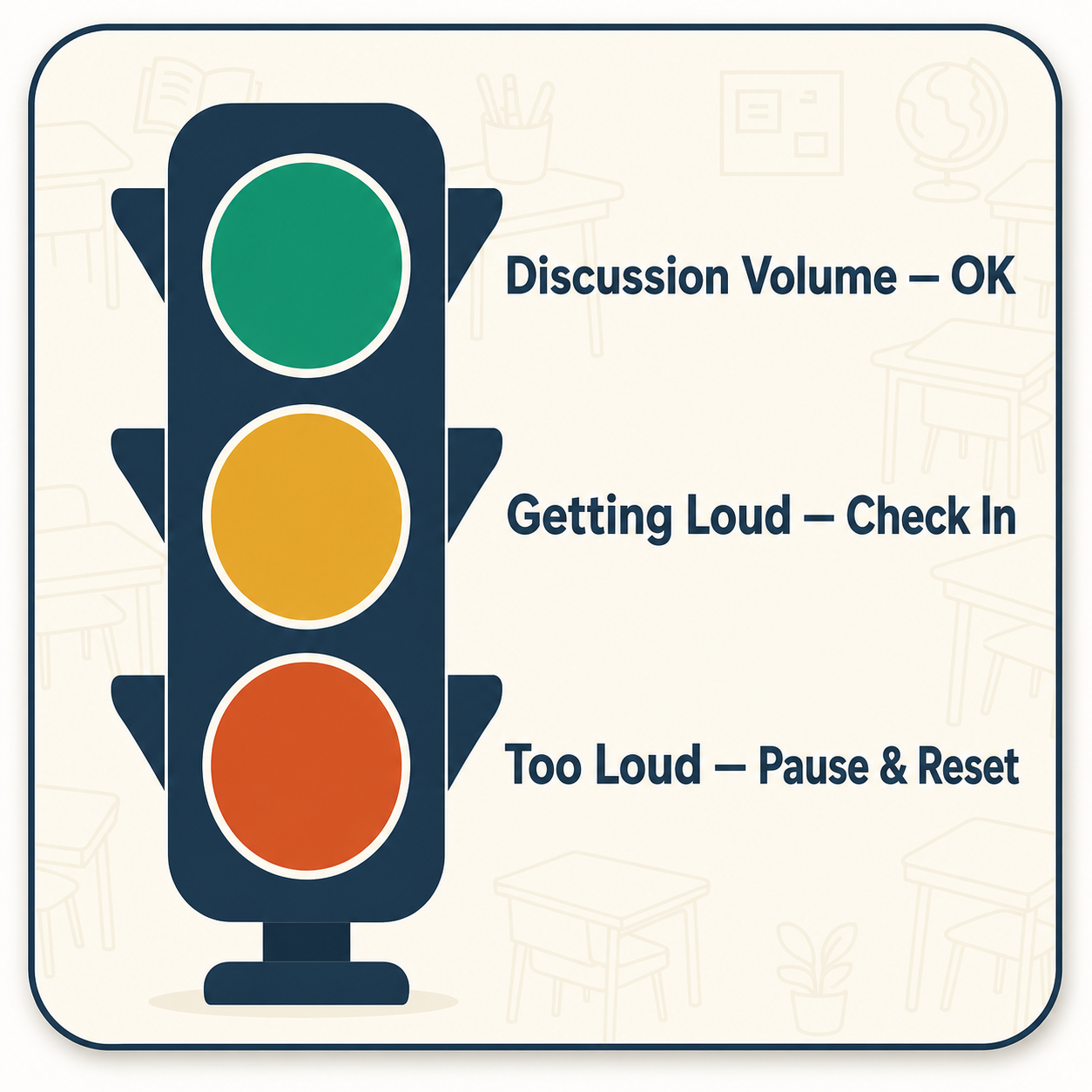
Tell students explicitly: “This is a discussion-volume activity — I should be able to hear the pair next to you, not the pair across the room.” Vague instructions like “quietly” mean nothing to a teenager. A concrete reference point does.
9. Keep group work under 6 minutes for large classes
The bigger the class, the faster on-task group work degrades into social chatter — simply because monitoring 15 pairs is harder than monitoring 5. Short, timed bursts (4-6 minutes) with a visible countdown keep the activity from outlasting anyone’s focus, and you can always run a second round.
10. Walk a fixed route, not a random one
During pair or group work, walk the same path around the room every time rather than wandering randomly. Students learn they can’t predict when you’ll be near them, which keeps every group accountable — not just the ones closest to your desk.
Marking & Feedback Without Burning Out
Forty-five students means forty-five copybooks. If your feedback system doesn’t scale, you’ll either stop giving feedback or stop having evenings.
11. Use symbol-based correction instead of full rewrites
A simple, consistent set of margin symbols (a circle for spelling, an underline for grammar, a checkmark for a strong sentence) lets you mark a full set of copybooks in a fraction of the time full-sentence corrections take — and it trains students to self-correct, which is a skill full rewrites never teach.
12. Mark a rotating third of the class per assignment
You don’t have to deeply correct all 45 books every single time. Rotate which third of the class gets full, detailed feedback each assignment, while the rest get a quick completion check. Over a month, everyone’s had thorough feedback — but no single evening cost you three hours.
Where this gets easier
If you’re building lessons from scratch every week on top of all this, that’s the real time-sink. The Smart English Worksheets Complete Pack comes with a full, pre-written answer key for every one of its 60 worksheets — built specifically so marking doesn’t eat your evening. If you just want to try a few lessons first, the free Worksheet Library has several available at no cost.
Putting It Together
None of these twelve strategies require a smaller class, a projector, or extra budget — they’re built around the classroom you actually have. Start with two or three, not all twelve at once: a silent attention signal and a fixed instruction sequence alone will noticeably change how your next lesson feels.
If you’re looking for full, ready-to-teach lessons that already build these kinds of routines into their structure — warm-ups that work with 40+ students, activities that need zero extra materials — the Smart English Worksheets Complete Pack is a solid place to start. And if staying organized across a full timetable of large classes is its own challenge, the Teacher Bundle is built around exactly that — a Record Book with a yearly pacing guide and daily lesson log, plus a Tracker with seating charts for up to 48 students and grade sheets that follow the Moroccan marking system. The Textbook Directory can also point you to material matched to your exact level and textbook.
There’s no official cutoff, but most Moroccan public secondary classes running 40 students or more are considered large by both teachers and researchers — some reach 50. Research generally associates classes above roughly 20-25 students with a noticeable rise in management and acquisition difficulty, which is part of why Moroccan classrooms are so often flagged as a distinct challenge in EFL research.
Use a fixed, silent signal — such as a hand-count from five to one — taught once at the very start of the year and used identically every single time. Consistency matters more than the specific signal you choose; the goal is that students respond to the signal itself, not to your volume.
Give an explicit, concrete volume reference (“discussion volume, not shouting volume”), keep the activity short — under six minutes — and walk a fixed, predictable route around the room while it runs. Short, tightly time-boxed activities hold together far better than open-ended ones in large groups.
Use a simple, consistent symbol-based correction system instead of full rewrites, and rotate which third of the class gets deep, detailed feedback on any given assignment rather than marking every book in full every time.
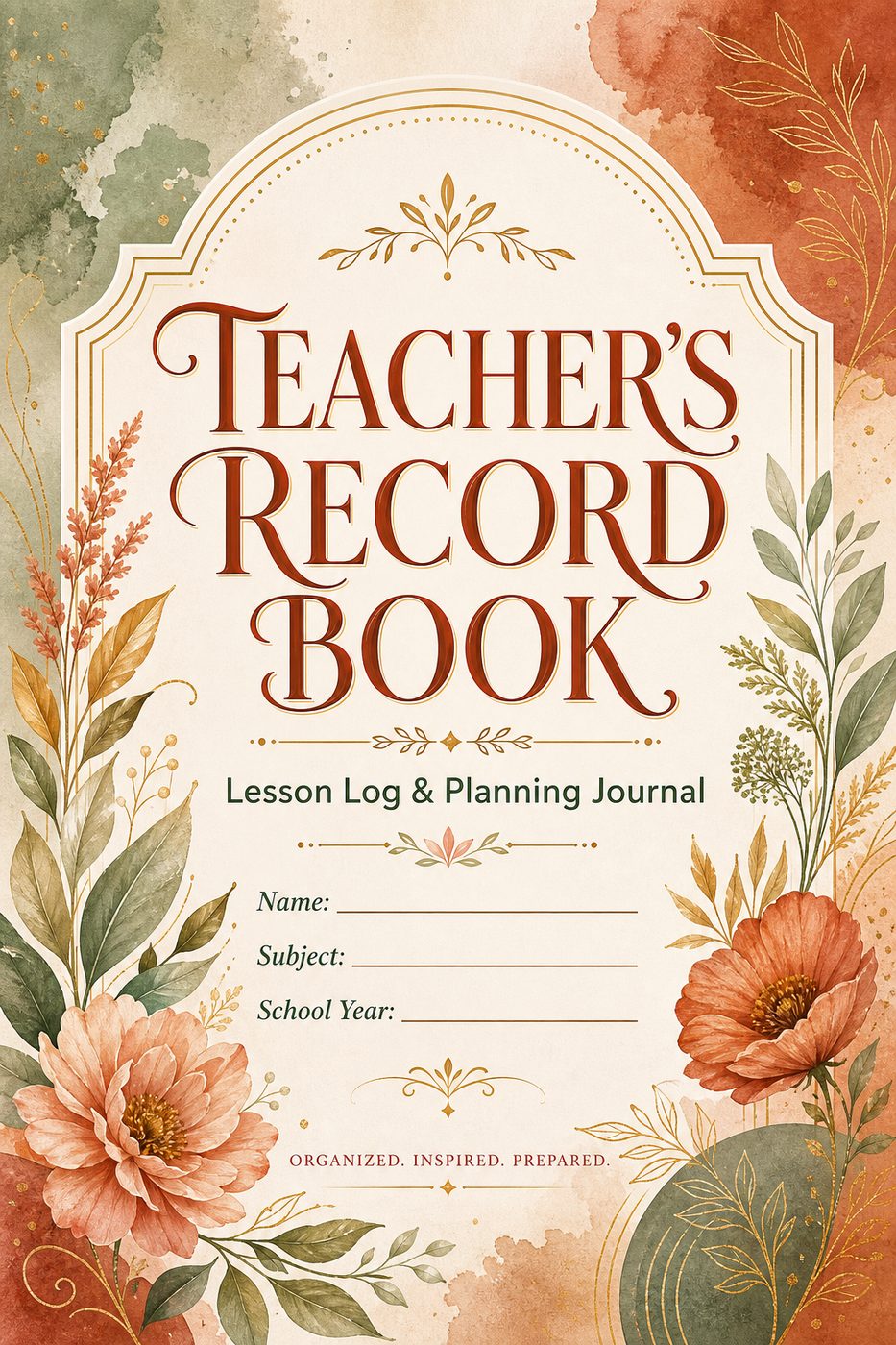
The Teacher Bundle
A complete Record Book, Tracker, and bonus Lesson Planner — everything to plan, teach, and track your school year in one beautiful set.
Discover The Teacher Bundle →
Scan with your phone camera, then tap "Install" on the site to add it to your home screen.
Or open myteacher.ma on your phone