
Clarification & Requests
Two exam functions in one lesson: showing you don't understand and asking someone to explain — plus making, accepting, and declining requests.
What this lesson covers
Real conversations don’t always go smoothly. Sometimes we don’t understand and need things explained, and sometimes we need to ask people for help. This lesson gives you the English for both — two functions that appear often in the national exam.
ماذا يغطّي هذا الدرس؟
لا تسير المحادثات دائمًا بسلاسة. أحيانًا لا نفهم ونحتاج إلى توضيح، وأحيانًا نحتاج أن نطلب المساعدة من الآخرين. في هذا الدرس ستتعلّم كيف تُظهر عدم الفهم وتطلب التوضيح، وكيف تقدّم طلبًا وتقبله أو ترفضه بأدب. هاتان الوظيفتان تظهران كثيرًا في الامتحان الوطني.
Lack of Understanding & Asking for Clarification
What to say when you don't understand — and how to ask someone to explain.
Showing you don't understand
When you don’t follow what someone said, say so politely. These expressions tell the other person you need help.
Asking for clarification
Then ask the person to explain, repeat, or give an example. These follow naturally after showing you didn’t understand.
See it in a conversation
Teacher: Today we’ll study satire.
Student: Sorry, I don’t quite follow. What do you mean by “satire”?
Teacher: It’s humour used to criticise something.
Student: Could you give an example, please?
Teacher: A cartoon that makes fun of a politician.
Student: I understand now, thank you.
Introduces a new word.
Shows lack of understanding + asks what it means.
Explains.
Asks for an example (clarification).
Gives one.
Confirms understanding.
Making, Accepting & Declining Requests
How to ask someone to do something — and how to say yes or no politely.
Making a request
To ask someone to do something, use these polite question forms. The further down the list, the more polite.
Would you mind closing the window?
Accepting and declining
When someone asks you, you can say yes (accept) or no (decline) — politely either way.
Sure, no problem.
Of course.
Certainly.
Yes, I’d be happy to.
No problem at all.
I’m sorry, but I can’t right now.
I’m afraid I can’t.
I’d love to, but I’m busy.
Sorry, I’m not able to.
Unfortunately, I can’t at the moment.
Common mistakes to avoid
❌ What you mean? → ✅ What do you mean?
❌ Declining with just “No.” → ✅ “I’m sorry, but I can’t right now.” (add a reason)
Your turn — choose the best response
-
1. “Sorry, I don’t follow you.” — This shows ___.
-
2. Which asks for clarification?
-
3. Which is a polite request?
-
4. “Would you mind ___ the door?”
-
5. Which one ACCEPTS a request?
-
6. Which one DECLINES politely?
-
7. To ask someone to repeat, say:
-
8. Which is the MOST polite request?
-
9. “Could you give an example?” is ___.
-
10. When you decline, you should add ___.
-
11. Choose the correct question.
-
12. “I beg your pardon?” shows you ___.
Write short responses for each situation:
- Your teacher uses a word you don’t know. (Show you don’t understand + ask what it means.)
- You want a classmate to lend you a pen. (Make a polite request.)
- A friend asks you to help move house, but you’re busy. (Decline politely with a reason.)
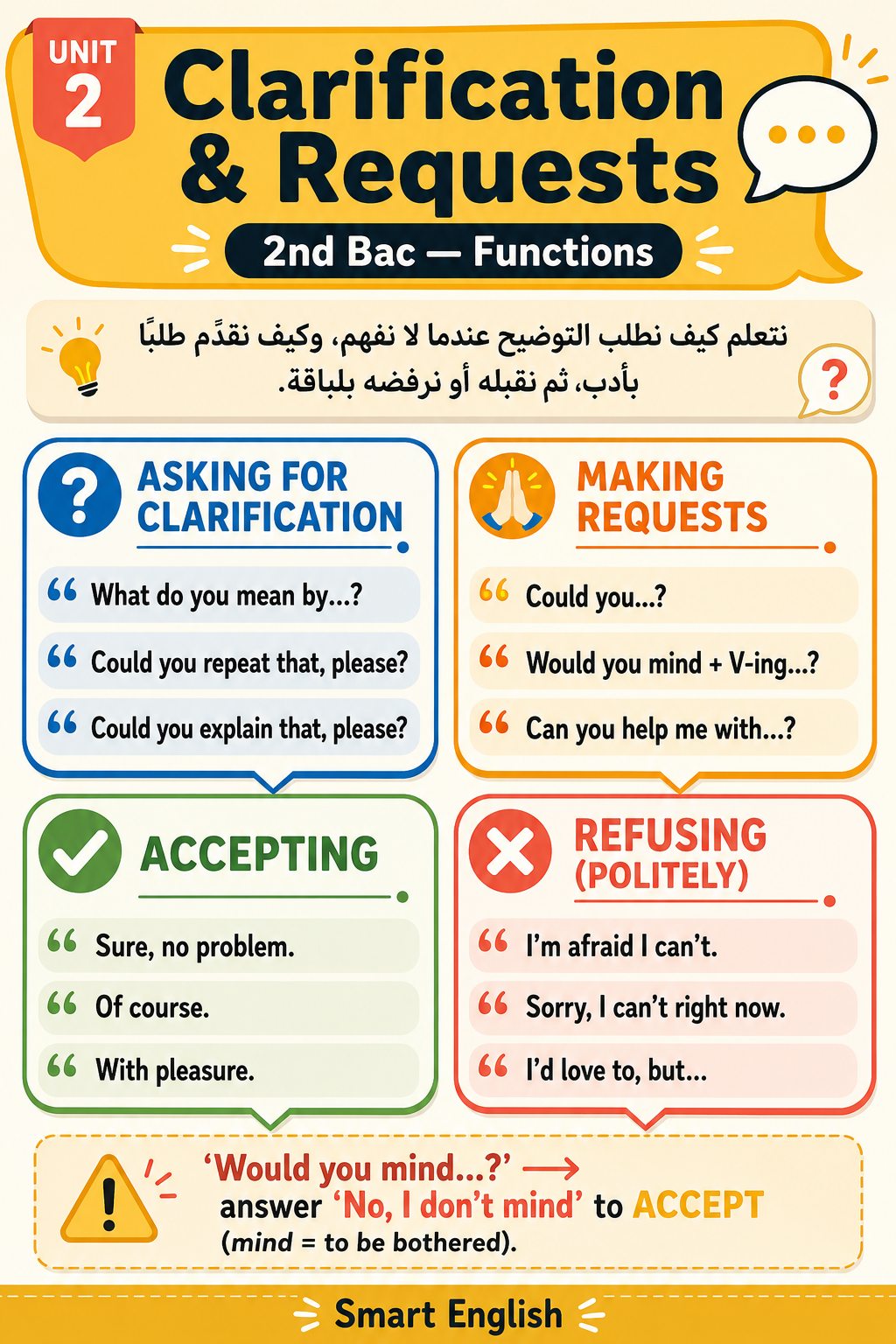
Here's your gift 🎁
A one-page summary of both functions — clarification and requests — with all the key expressions. Save it and revise before your exam.
⬇ Get your gift
Smart English: From Stress to Success
40 visual lessons for all 10 units, a full exam guide, 3 sample exams, and a complete glossary — everything in one beautiful book.
Discover Smart English →
Scan with your phone camera, then tap "Install" on the site to add it to your home screen.
Or open myteacher.ma on your phone