
Modal Verbs
Learn to express ability, obligation, advice, possibility, and deduction — the modals the exam tests most.
What are modal verbs?
Modal verbs are small helper words — can, could, may, might, must, should — that go before the main verb to add meaning: ability, permission, obligation, advice, or possibility. They never change form and are always followed by the base verb (no “to”, no “-s”, no “-ing”).
ما هي الأفعال الشرطية (Modal Verbs)؟
الأفعال الشرطية هي كلمات مساعدة صغيرة — مثل can, could, may, might, must, should — توضع قبل الفعل الأساسي لإضافة معنى: القدرة، الإذن، الإلزام، النصيحة، أو الاحتمال. لا تتغير هذه الأفعال أبدًا، وتُتبع دائمًا بالفعل في صيغته الأساسية (بدون “to”، وبدون “s”، وبدون “ing”).
Ability and permission
Use these modals to talk about what someone is able to do, or is allowed to do.
can — present ability
I can speak English.
could — past ability
I could swim at five.
be able to — all tenses
She’ll be able to drive soon.
can — informal permission
You can leave early.
may — formal permission
May I come in?
could — polite request
Could I ask a question?
Obligation, necessity and advice
These modals are the most exam-tested group. The exact word you choose changes the meaning.
Don’t have to = not necessary, but allowed. You don’t have to come, but you can. These are opposite meanings — never mix them up.
Possibility and deduction
Modals also let you guess or judge how likely something is — about now, or about the past.
Certain → must (positive) / can’t (negative): He must be tired. / She can’t be serious.
A worked example
My friend looks tired today; he must have stayed up late revising.
He can’t have finished the exam already — it’s only been ten minutes.
She might have forgotten about the meeting.
Strong deduction — almost certain (past).
Strong negative deduction — almost impossible (past).
A guess — maybe true, not certain (past).
Common mistakes to avoid
❌ He can to swim. → ✅ He can swim. (no “to” after most modals)
❌ You mustn’t to worry, it’s not necessary. → ✅ You don’t have to worry. (mixing up mustn’t and don’t have to)
Your turn — choose the correct modal
-
1. I ___ speak three languages.
-
2. You ___ smoke in the hospital — it’s forbidden.
-
3. You ___ come to the party if you don’t want to — it’s optional.
-
4. Students ___ wear a uniform at this school — it’s the rule.
-
5. She looks exhausted; she ___ have worked all night.
-
6. It’s only 8am, he ___ have arrived already — the flight lands at 10.
-
7. It ___ rain later — the sky looks cloudy but it’s not certain.
-
8. You ___ revise more if you want to pass.
-
9. Choose the correct sentence.
-
10. “He must have missed the bus” expresses ___.
-
11. Choose the correct sentence.
-
12. “Could I ask a question?” is an example of ___.
Complete each sentence with the modal that best fits the meaning in brackets:
- You ___ arrive on time for the exam. (strong obligation)
- She ___ be at home — I saw her leave an hour ago. (certain it’s NOT true)
- You ___ bring your ID card, but it’s a good idea. (not necessary)
- He ___ have forgotten our meeting. (a guess about the past)
- ___ I open the window, please? (polite permission)
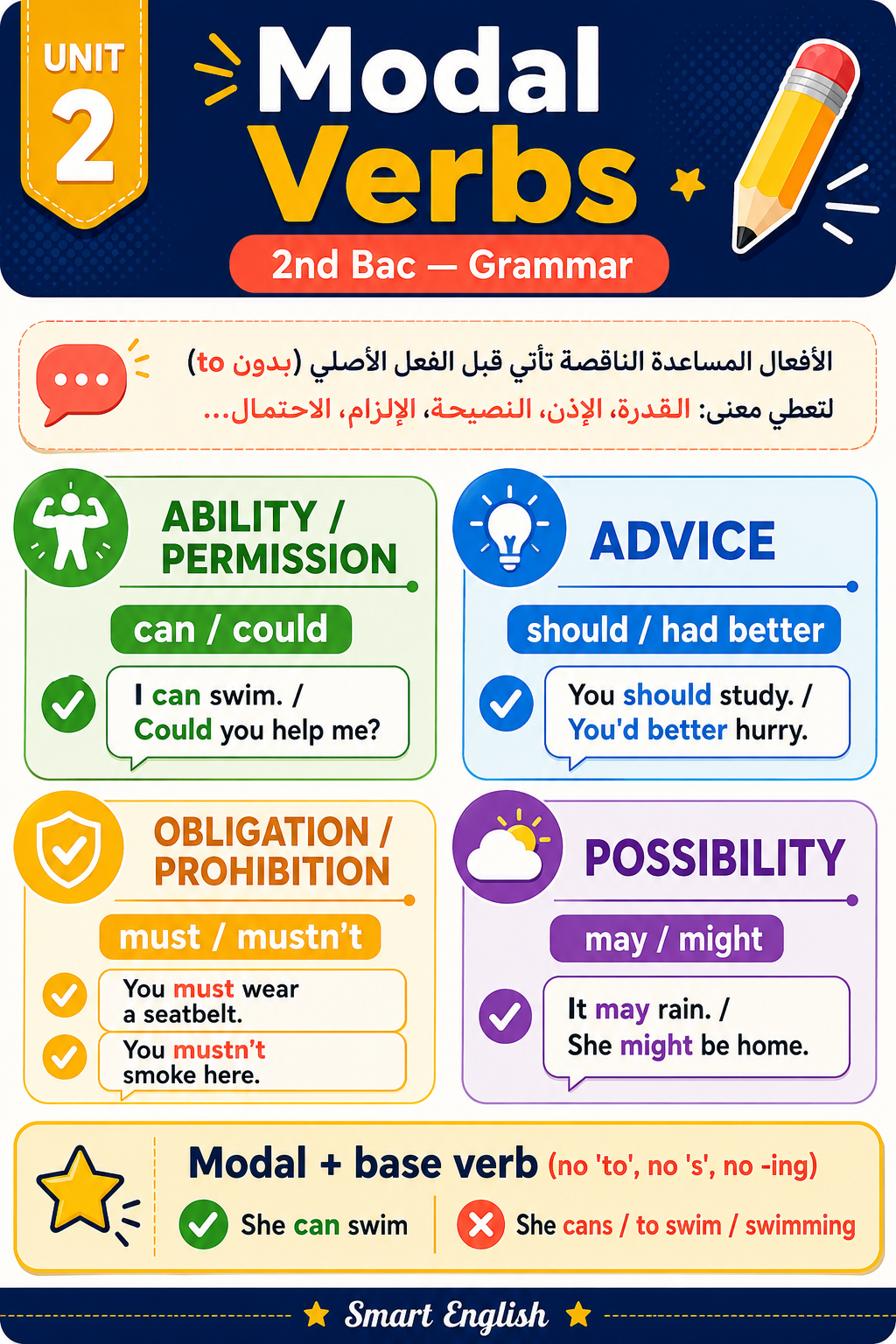
Here's your gift 🎁
A one-page summary of modal verbs — ability, obligation, advice, possibility, and deduction. Save it and revise before your exam.
⬇ Get your gift
Smart English: From Stress to Success
40 visual lessons for all 10 units, a full exam guide, 3 sample exams, and a complete glossary — everything in one beautiful book.
Discover Smart English →
Scan with your phone camera, then tap "Install" on the site to add it to your home screen.
Or open myteacher.ma on your phone