
Writing a Funny Story
Learn to tell a short, funny narrative — with the right structure, past tenses, and a punchline that lands.
What the exam asks
In this writing task, you tell a short true or invented story that makes the reader smile — often something that happened to you, a friend, or a family member. Unlike a descriptive paragraph, a funny story is about events happening in order, ending in something unexpected or amusing.
ماذا يطلب الامتحان؟
في هذا النوع من الكتابة، تحكي قصة قصيرة حقيقية أو من خيالك تجعل القارئ يبتسم — غالبًا حدث وقع لك، لصديق، أو لأحد أفراد العائلة. على عكس الفقرة الوصفية، القصة المضحكة تتحدث عن أحداث متسلسلة بترتيب زمني، وتنتهي بشيء مفاجئ أو طريف.
The five ingredients
Every good funny story needs these five elements. Miss one and the story feels flat.
The structure
Follow this simple shape every time — it keeps your story clear and builds naturally toward the funny ending.
Opening — set the time and place. “One sunny afternoon, my cousin and I were walking home from school.”
Use the past tenses correctly
A story is told in the past. Use past simple for the main events, and past continuous for actions already in progress when something else happened.
He opened the door.
She dropped her bag.
Everyone laughed.
While he was opening the door, the cat ran out.
She was carrying her bag when she dropped it.
We were walking when it started to rain.
Link your events smoothly
Time connectors carry the reader from one event to the next — they’re what make a story flow instead of feeling like a list.
A model story
Here is a short funny story. Notice the structure and the past tenses.
Last summer, my brother and I were washing our father’s car in the garden. (opening — time, place) While he was rinsing the roof, I was holding the hose at the other end, not paying attention. (build-up, past continuous) Suddenly, he shouted my name, and I turned around — right into the full blast of water! (the twist) We were both soaked from head to toe, and we couldn’t stop laughing for ten minutes. (closing line)
Opening: sets time and place.
Build-up: two actions happening together.
Twist: the unexpected funny moment.
Closing: a short final reaction.
Common mistakes to avoid
❌ Wrong tense: “Yesterday I go to school.” → ✅ “Yesterday I went to school.”
❌ Too many events: trying to fit five things in — pick ONE clear incident and tell it well.
Your turn — test your understanding
-
1. A funny story should end with a ___.
-
2. Which tense is used for the MAIN events of a story?
-
3. Choose the correct sentence.
-
4. “Suddenly” is an example of a ___.
-
5. Where should the funny twist usually appear?
-
6. Which sentence uses past continuous correctly?
-
7. A good funny story needs how many key ingredients?
-
8. Choose the correct sentence.
-
9. “In the end” is used to ___.
-
10. What’s the biggest mistake in a funny story?
-
11. Past continuous is often used with which word?
-
12. A good opening line does what?
Write a short funny story (about 8–10 sentences) about ONE of these:
- A funny thing that happened at school
- A prank that didn’t go as planned
- An embarrassing moment with your family
Remember: set the scene → build up → deliver the twist → close with a short reaction. Use past simple and past continuous, and at least two time connectors.
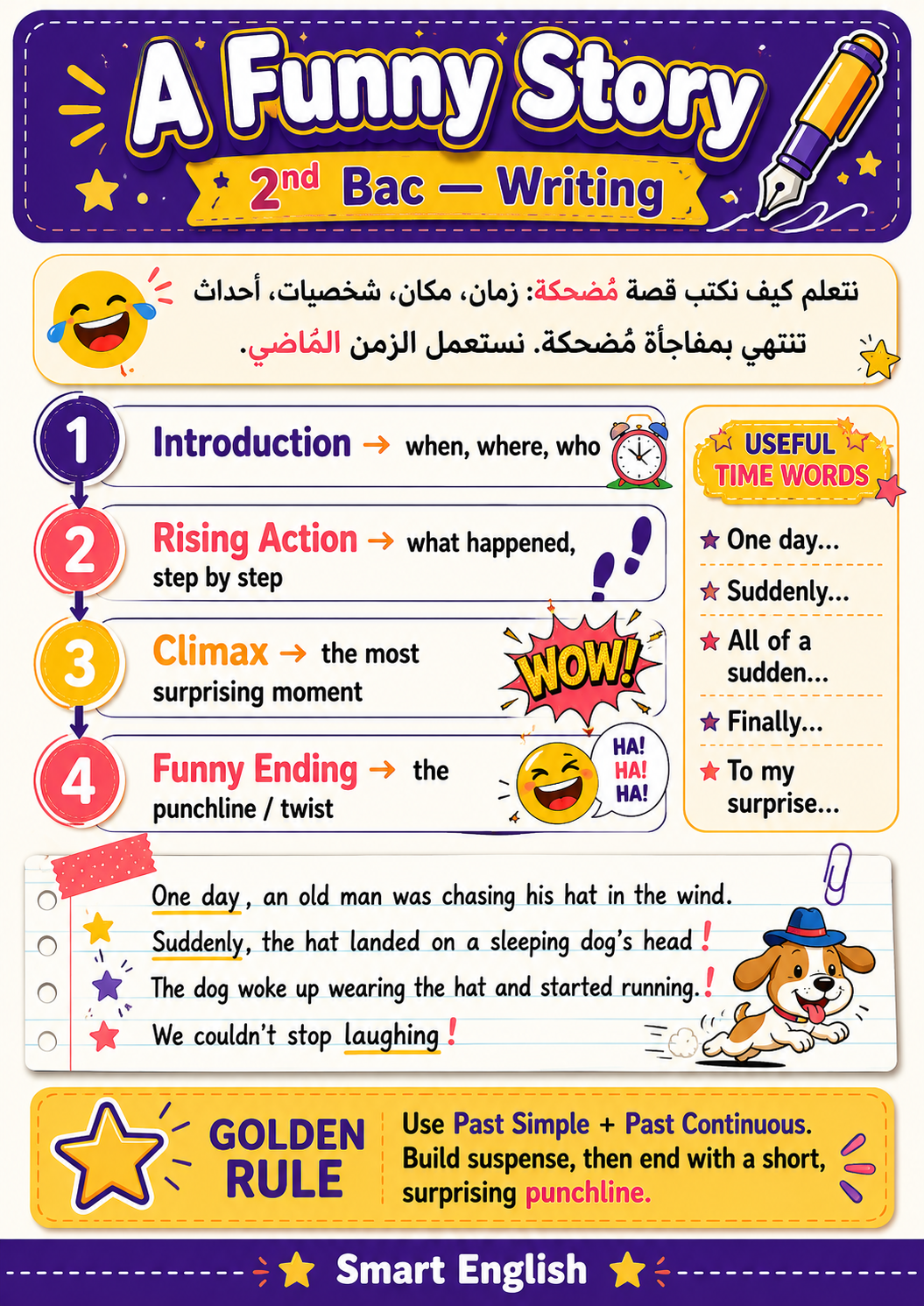
Here's your gift 🎁
A one-page summary of how to write a funny story — structure, tenses, and connectors. Save it and use it for every narrative writing task.
⬇ Get your gift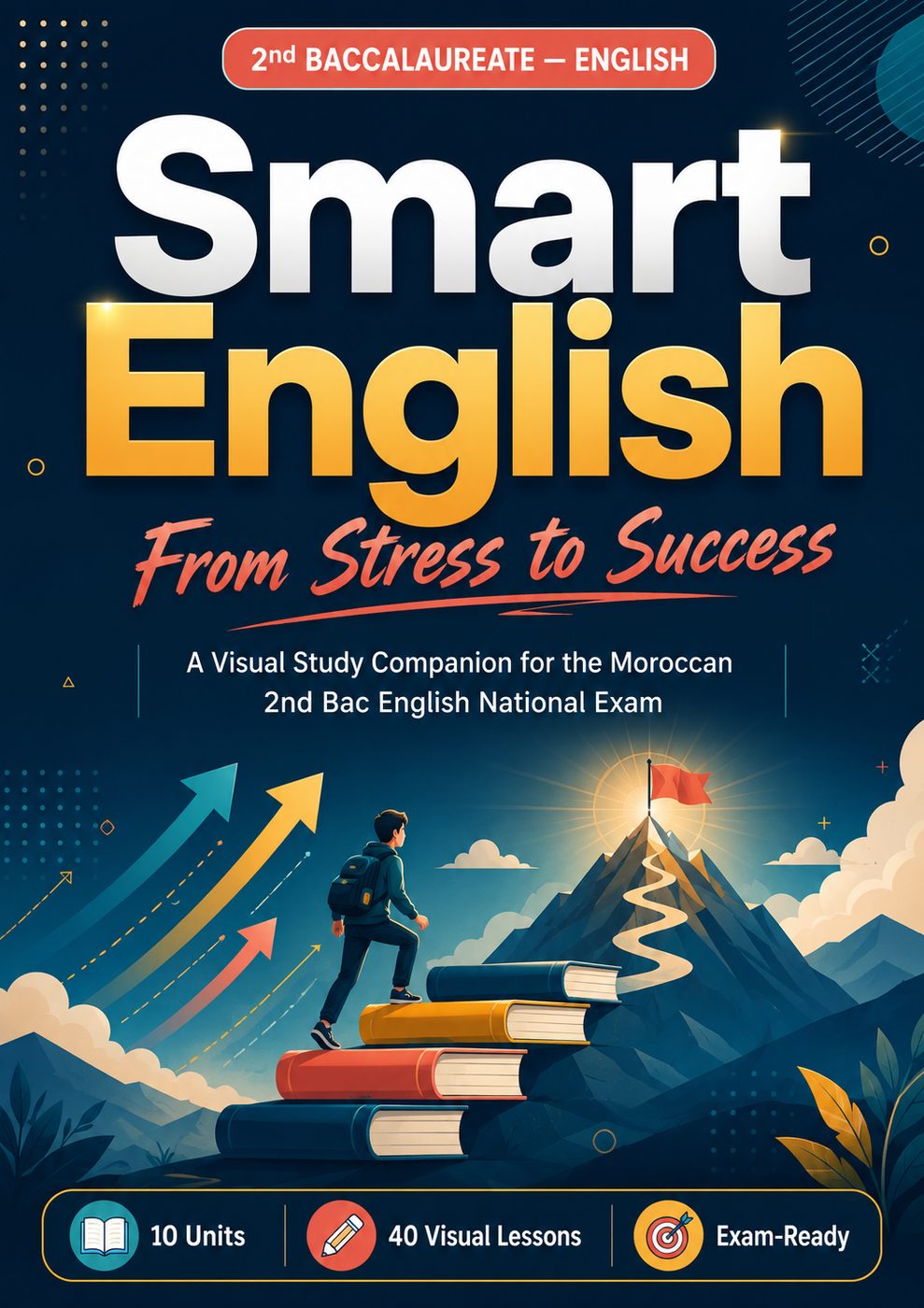
Smart English: From Stress to Success
40 visual lessons for all 10 units, a full exam guide, 3 sample exams, and a complete glossary — everything in one beautiful book.
Discover Smart English →
Scan with your phone camera, then tap "Install" on the site to add it to your home screen.
Or open myteacher.ma on your phone