
The Gifts of Youth
Learn the words that describe the energy, talent, and dreams of young people — and how to build adjectives from nouns.
What is this lesson about?
Youth is a time full of energy, curiosity, and dreams. This lesson gives you the vocabulary to describe these qualities in English — the words you need to talk about young people, and the words that often appear in your Baccalaureate exam.
عن ماذا يتحدث هذا الدرس؟
الشباب مرحلة مليئة بالطاقة والفضول والأحلام. في هذا الدرس ستتعلّم الكلمات التي تصف صفات الشباب باللغة الإنجليزية، وهي كلمات تظهر كثيرًا في امتحان الباكالوريا. الفكرة الأساسية: تعلّم الاسم والصفة لكل كلمة، وكيف تتحوّل الكلمة من اسم إلى صفة.
Key words: noun and adjective
Most youth vocabulary comes in pairs — a noun (the quality itself) and an adjective (to describe a person). Learn both forms together.
talent — a natural ability
ambition — a strong wish to succeed
creativity — the power to create new ideas
imagination — forming new pictures in the mind
flexibility — being open to change
curiosity — a wish to learn and know
talented — She is a talented singer.
ambitious — He is ambitious and hard-working.
creative — They are creative thinkers.
imaginative — An imaginative child.
flexible — A flexible young mind.
curious — A curious student asks questions.
More youth qualities
Here are more useful words to describe young people. Try to use two or three of them in sentences about yourself.
The secret: building adjectives from nouns
Here is the skill that unlocks exam questions. You can often turn a noun into an adjective by adding an ending (a suffix). Learn the common patterns.
Add -ous → ambition becomes ambitious, adventure becomes adventurous
Useful collocations
Collocations are words that naturally go together. Examiners love these — using them makes your English sound natural.
The generation gap can make it hard for parents and teenagers to understand each other.
Common mistakes to avoid
❌ She is talent. → ✅ She is talented.
❌ He has a lot of ambitious. → ✅ He has a lot of ambition.
Use the noun after “a lot of / much / has”, and the adjective after “is / are / very”.
Your turn — choose the correct word
-
1. My little sister is very ___. She loves painting and inventing stories.
-
2. He has a lot of ___ and wants to become a doctor.
-
3. Young people are often ___ ; they enjoy trying new and exciting things.
-
4. She is a ___ musician — she learned the piano in just one year.
-
5. Their teacher is ___ and always finds new ways to explain lessons.
-
6. Staying ___ helps you adapt when plans suddenly change.
-
7. His ___ pushes him to ask “why?” about everything.
-
8. A good leader is ___ and believes things will get better.
-
9. Many teenagers want to ___ their dreams after school.
-
10. The ___ gap sometimes makes it hard for parents and teens to agree.
-
11. She spoke with great ___ about protecting the environment.
-
12. Being ___ means you enjoy meeting and talking to new people.
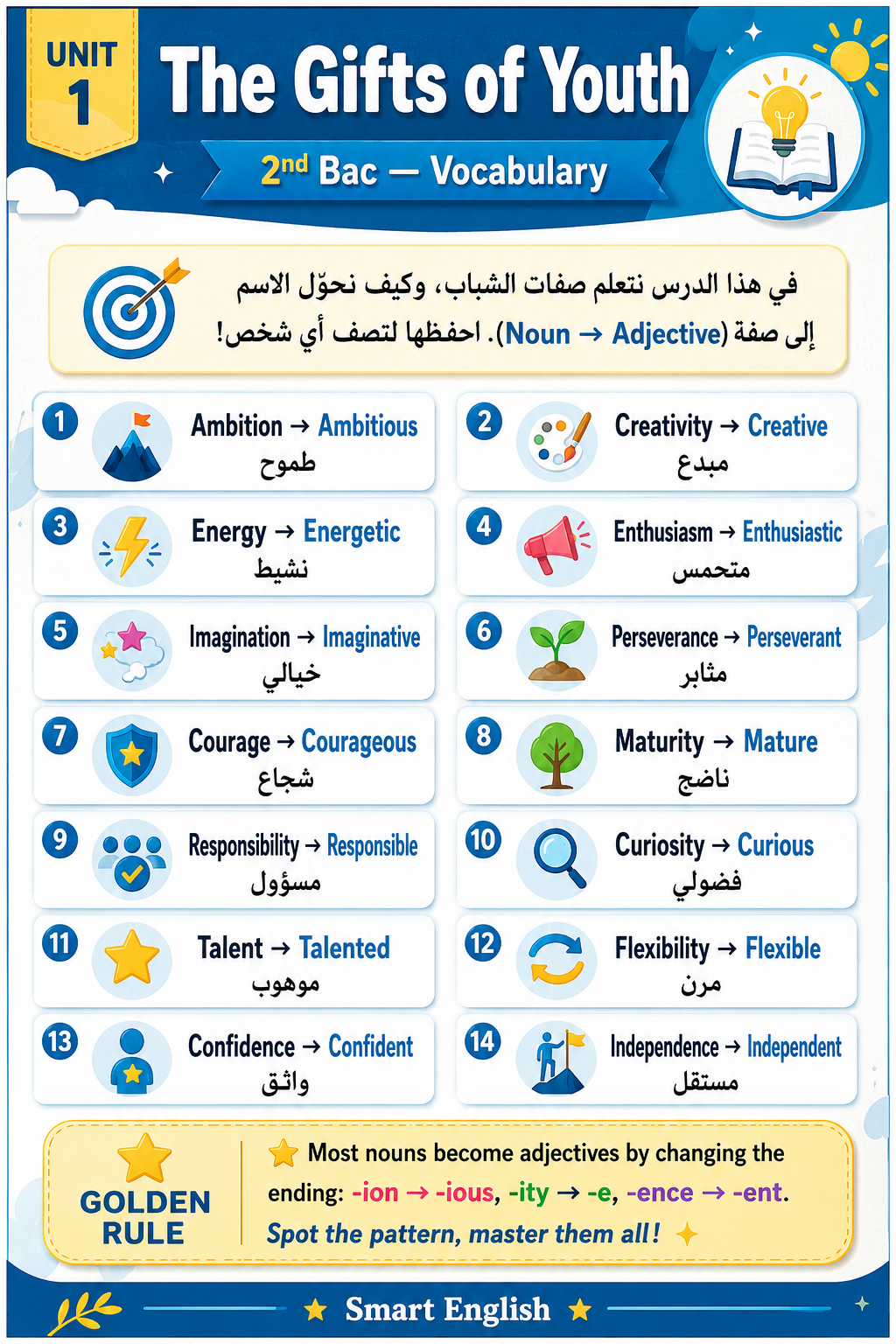
Here's your gift 🎁
A one-page summary of all the Gifts of Youth vocabulary — save it to your phone and revise before your exam.
⬇ Get your gift
Smart English: From Stress to Success
40 visual lessons for all 10 units, a full exam guide, 3 sample exams, and a complete glossary — everything in one beautiful book.
Discover Smart English →
Scan with your phone camera, then tap "Install" on the site to add it to your home screen.
Or open myteacher.ma on your phone