
Conditional Type 3 and Wishes
Learn to talk about the past that never happened — imagined outcomes, and the regrets that come with them.
What conditional type 3 does
Conditional type 3 talks about an imagined result of an imagined past condition — something that didn’t actually happen. It’s used for regrets and “what if” thinking about the past, when it’s too late to change anything.
ما وظيفة الجملة الشرطية من النوع الثالث؟
تتحدث الجملة الشرطية من النوع الثالث عن نتيجة متخيَّلة لشرط متخيَّل في الماضي — شيء لم يحدث فعليًا. تُستخدم للتعبير عن الندم والتفكير في “ماذا لو” بخصوص الماضي، بعد فوات الأوان لتغيير أي شيء.
The formula
If he hadn’t been careless, the experiment wouldn’t have failed.
Would, could, or might have
Certain result.
If I had left earlier, I would have caught the bus.
Possible or uncertain result.
If I had studied more, I could have got a better mark. (ability/possibility)
If it hadn’t rained, we might have gone out. (uncertain)
Wishes about the past
Wishes about the past use the same idea as conditional type 3 — regret about something that already happened, or didn’t happen.
I wish I hadn’t said that to him.
Conditional 3 and wishes — the connection
These two structures express the same regret, just in different sentence shapes. Being able to switch between them is a common exam task.
If I had known about the experiment, I would have joined it.
I wish I had known about the experiment.
Common mistakes to avoid
❌ She would have pass the exam. → ✅ She would have passed the exam. (use the past participle)
❌ I wish I studied harder. → ✅ I wish I had studied harder. (wishes about the past need “had + past participle”)
Your turn — choose the correct form
-
1. If she ___ harder, she would have passed the exam.
-
2. If the ambulance had arrived on time, the man ___ died.
-
3. Choose the correct sentence.
-
4. I wish I ___ harder for the exam.
-
5. Choose the correct sentence.
-
6. “If only” is closest in meaning to ___.
-
7. If it hadn’t rained, we ___ gone out. (uncertain result)
-
8. Choose the correct sentence.
-
9. Conditional type 3 talks about ___.
-
10. Choose the correct sentence.
-
11. Which shows CERTAINTY in the result?
-
12. Rewrite as a wish: “If only I had studied more” means the same as ___.
Rewrite each sentence using conditional type 3 or a wish, as instructed:
- She didn’t study, so she failed the exam. (Rewrite using “If”)
- He missed the bus because he woke up late. (Rewrite using “If”)
- I didn’t visit my grandmother last summer. (Rewrite using “I wish”)
- They didn’t win the competition because they didn’t prepare well. (Rewrite using “If”)
- She regrets not learning to code. (Rewrite using “I wish”)
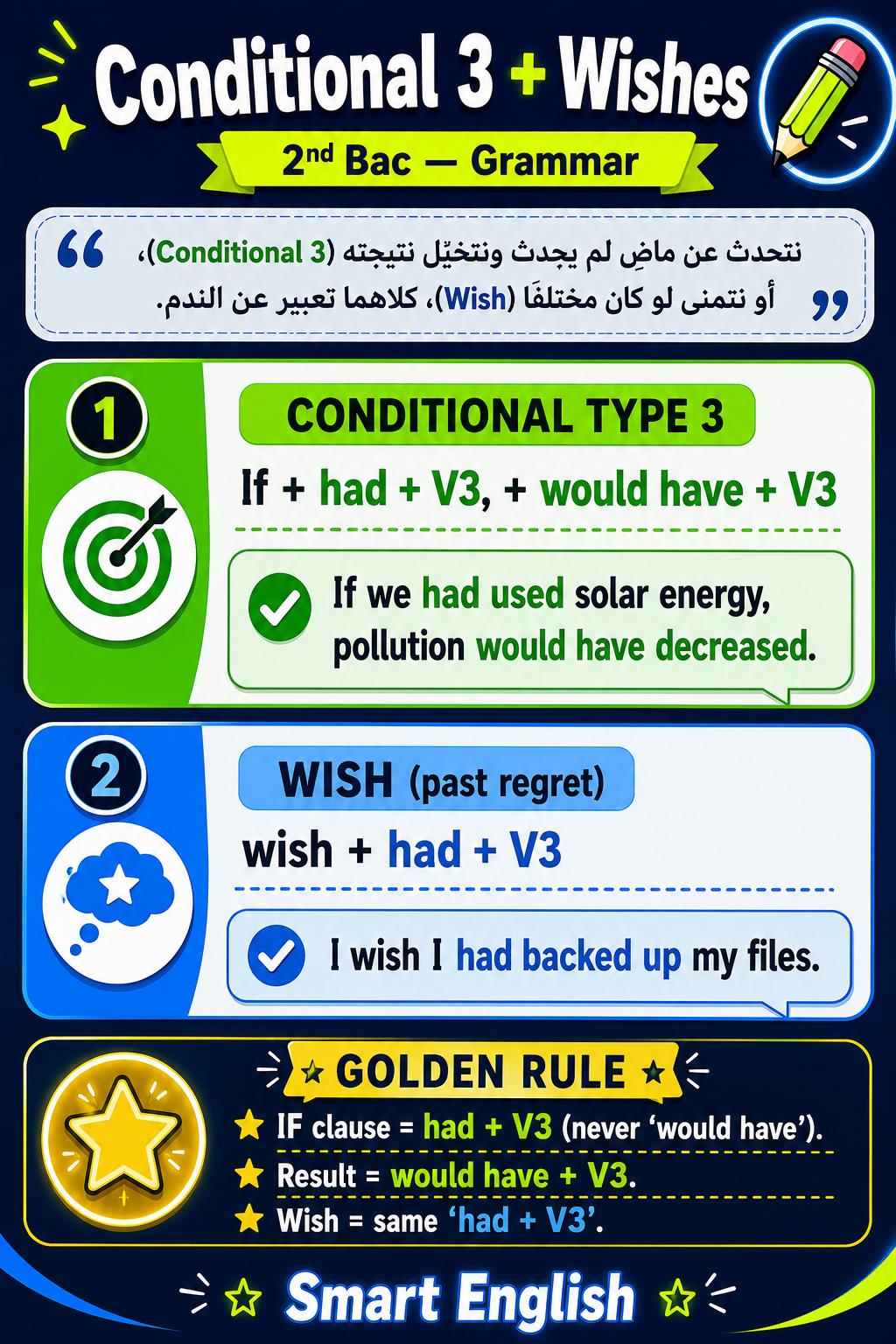
Here's your gift 🎁
A one-page summary of conditional type 3 and wishes — formulas, examples, and the connection between them. Save it and revise before your exam.
⬇ Get your gift
Smart English: From Stress to Success
40 visual lessons for all 10 units, a full exam guide, 3 sample exams, and a complete glossary — everything in one beautiful book.
Discover Smart English →
Scan with your phone camera, then tap "Install" on the site to add it to your home screen.
Or open myteacher.ma on your phone