
Learn how to compare two things in English using comparative adjectives! A simple, beginner grammar…
When we go shopping, we talk about our own things and other people’s things a lot — “my bag,” “her dress,” “his shoes.” Let’s learn the small words that make this possible.
1
Subject Pronouns
You already use some of these! Subject pronouns replace a person’s or thing’s name:
Subject Pronouns
Iyouhesheitwethey
Example
Hamza is my friend. He is 15.
This is a shop. It is big.
Hamza is my friend. He is 15.
This is a shop. It is big.
ضمائر الفاعل تحل محل اسم الشخص أو الشيء: I (أنا)، you (أنت)، he (هو)، she (هي)، it (هو/هي لغير العاقل)، we (نحن)، they (هم).
2
Possessive Adjectives
Possessive adjectives show that something belongs to someone. Each subject pronoun has its own possessive form:
Subject
he
Possessive
his
All Forms
I → my, you → your, she → her, it → its, we → our, they → their
الصفات الملكية تظهر ملكية الشيء لشخص ما. كل ضمير فاعل له صيغة ملكية خاصة: he → his، she → her، it → its، وهكذا.
3
Using Them Together
Let’s use pronouns and possessives together in real shopping sentences:
Example
This is my bag.
Is that his shirt?
Her dress is beautiful.
This shop and its prices are great.
This is my bag.
Is that his shirt?
Her dress is beautiful.
This shop and its prices are great.
💡 Easy Tip
Don’t confuse “it’s” (it is) with “its” (belongs to it) — they sound the same but mean different things!
Don’t confuse “it’s” (it is) with “its” (belongs to it) — they sound the same but mean different things!
نستخدم الضمائر والصفات الملكية معا في جمل حقيقية، مثل: “This is my bag” (هذه حقيبتي). انتبه لعدم الخلط بين “it’s” (هو/هي) و”its” (ملكية).
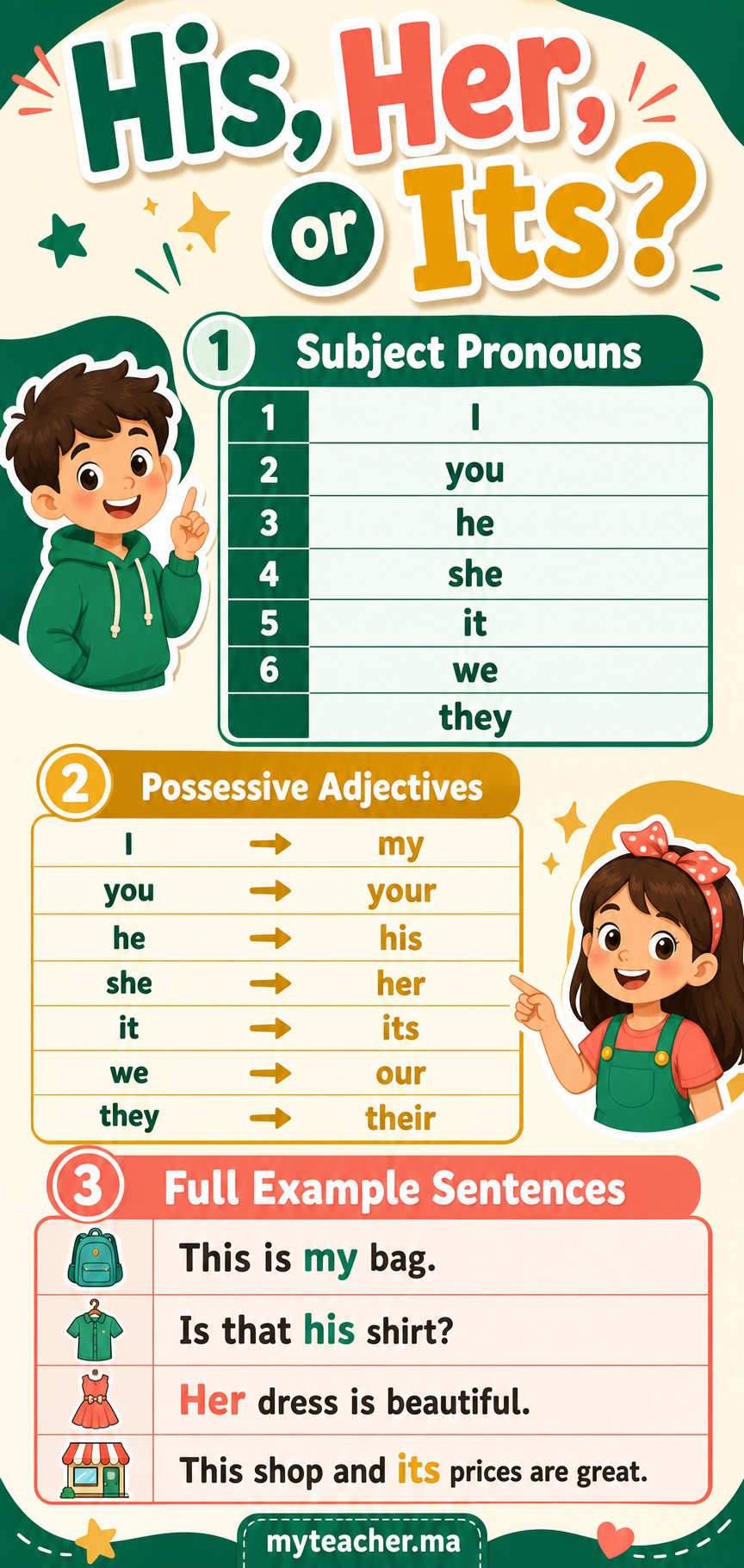
His, Her, or Its? — Summary Card
Save this card on your phone to remember today's lesson!
⬇ Download the Summary CardTest Yourself!
-
“Hamza is my friend. ___ is 15.”
-
The possessive form of “she” is ___.
-
The possessive form of “they” is ___.
-
“This is ___ bag.” (belongs to me)
Want More Lessons Like This?
This is one lesson from a full, illustrated study book for Common Core students — every unit, with practice and Arabic help for each lesson.
See the Complete Pack →
📱 Get MyTeacher as an app
Scan with your phone camera, then tap "Install" on the site to add it to your home screen.
Or open myteacher.ma on your phone